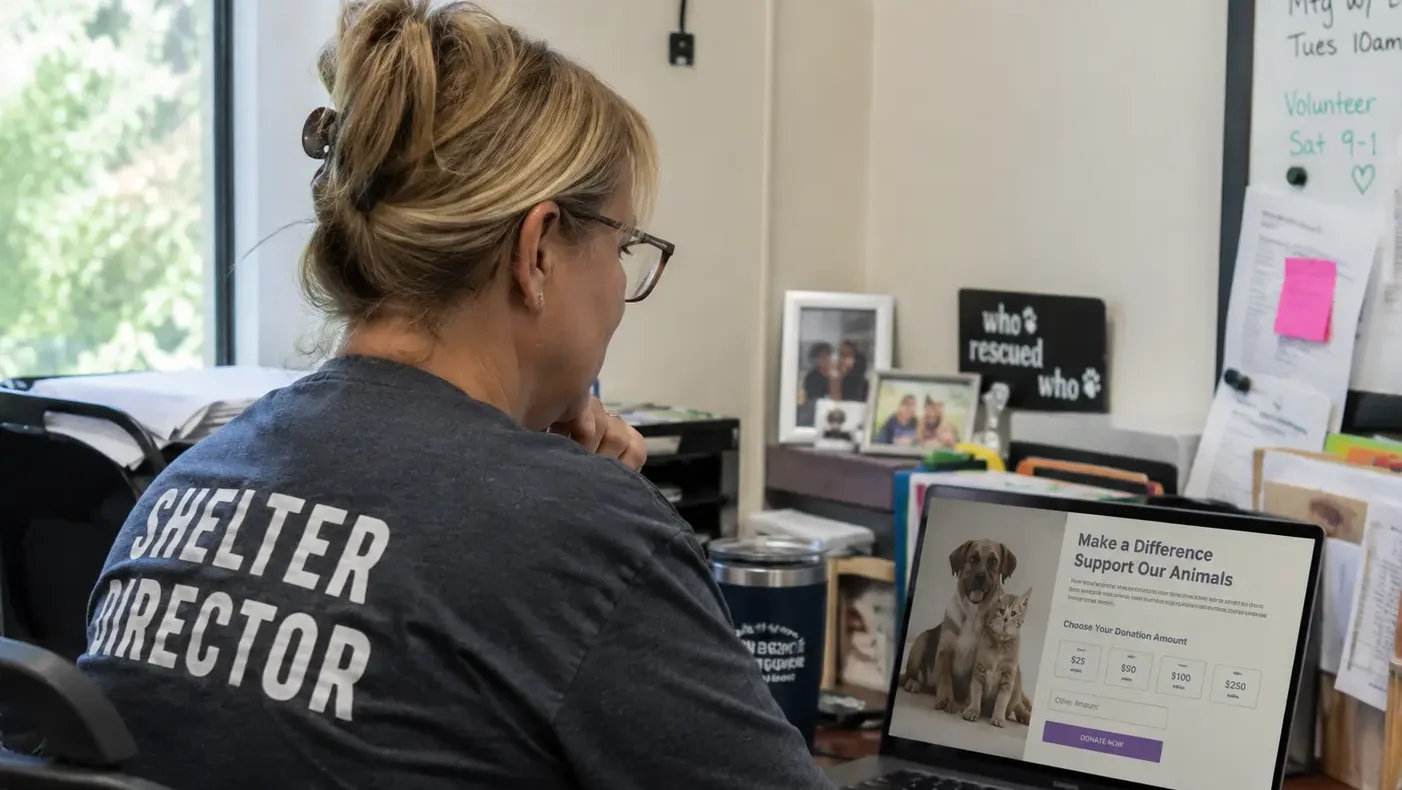
I visited a shelter in Ohio last spring.
They had three software tools running at once – shelter management, a donor CRM, a pet adoption platform.
They were raising less than $40,000 a year.
I’ve seen this at shelters in Texas, California, and Georgia. Great animal rescue software setup. Struggling fundraising.
What Animal Rescue Software Actually Does (And What It Doesn’t)
Animal rescue software handles operations. Intake tracking, medical records, volunteer schedules, adoption applications.
It’s a database for everything inside a shelter.
The tools are genuinely good at this Platforms like Shelterluv, ShelterBuddy, and PetPoint.
They made shelter management faster.
The global animal shelter software market was valued at around $405 million in 2024.
But here’s what nobody says: operations software and fundraising software are not the same thing.
Most shelters assume once the donor CRM is set up, donations follow. They don’t. Not automatically.
The Real Reason Shelters Stay Underfunded
Most shelter donation software is built around transactions, not connection.
It gives you a donate button – not a reason to click it.
Donors don’t give because the button is easy. They give because they care about a specific animal.
Think about two shelter emails.
One says “Help us reach our $10,000 goal.”
And other tells you about Biscuit, a three-legged dog found on a highway who wagged his tail at everyone.
You already know which one gets the donation.
Most animal welfare software records that Biscuit arrived March 12, weighs 34 pounds, and is available for adoption.
That’s data. That’s not a story.
What Actually Works in Animal Rescue Fundraising Software
The shelters raising the most money aren’t the biggest.
Some of the best fundraisers I’ve seen run 30-animal rescues with one part-time staff member.
What they have: A consistent habit of telling individual animal stories.
Research from the Stanford Social Innovation Review found donors respond far more to identified individuals than to statistics.
Shelter directors who get this use their pet adoption software as a story-starting point, not just a record.
Before: Shelter logs intake data. Sends monthly emails with donation goals.
Engagement is low. Recurring donors are rare.
After: Staff adds story notes and personality details to each profile.
Those feed email campaigns and donor updates.
Donors feel connected. Giving goes up.
The difference isn’t the software. It’s whether the software helps you find the story.
The Animal Welfare Software Stack Most Shelters Actually Need
Most shelters need two layers. Most shelters only have one.
Layer 1: Shelter operations – your shelter management software.
Shelterluv, ShelterBuddy, and Animal Shelter Manager all handle this well.
Layer 2: Donor storytelling – the layer that turns animal records into content that moves donors.
It’s the bridge between “47 animals in care” and “let me tell you about Marcy, the hound who sings when she hears jazz.”
Some nonprofit animal rescue tools are building toward this.
DonorPerfect and Giveffect offer donor CRM features. Zeffy is a strong zero-fee option for small shelters.
But none of them solve the storytelling problem at scale.
That’s the gap I keep seeing – and it’s exactly why I built BarkLogue.
What BarkLogue Is Built to Fix
I’ve spent 25 years building companies.
Most of what I learned came from watching smart people solve the wrong problem.
In animal rescue,
the wrong problem is: “How do we get more efficient?”
The right problem is: “How do we make donors feel something – consistently?”
BarkLogue is an AI platform that gives every shelter animal a voice.
It takes what your team knows and turns it into a real, specific story – not a template, not a generic rescue narrative.
The shelters we’ve worked with see donors who come back, share, and feel like they personally know the animals they support.
💡 Worried storytelling takes time you don’t have? It doesn’t – when the right tool does the heavy lifting.
That’s the whole point.
What You Can Do This Week
If you run a shelter: Ask yourself one question
Does your animal rescue software help you tell individual stories to donors? If not, that’s the gap to fix.
Your one action right now: pick the animal with the most interesting personality – not the saddest story, the most interesting one.
And write three sentences about who they are.
That’s the seed.
If you’re a donor or animal lover: Find a local rescue and ask them to tell you about a specific animal.
If they can, support them. If they can’t, share this post with their director.
Common Questions People Ask
What is animal rescue software?
Animal rescue software helps shelters manage operations: animal intake, medical records, adoption tracking, and donor management.
It ranges from free open-source tools to cloud platforms costing several hundred dollars per month.
What’s the best free animal rescue software?
Animal Shelter Manager is the most widely used free option – open-source, handles core shelter functions well.
Zeffy is also free for fundraising specifically.
Does animal rescue software help with fundraising?
Most shelter management software includes basic donation tools, but fundraising depth varies widely.
The gap most tools miss is storytelling – turning animal records into donor-facing content.
How much does shelter management software cost?
Most cloud-based animal shelter software runs $100-$1,500 per month depending on size and features.
Open-source options like Animal Shelter Manager are free but require self-hosting.
Do small rescues need animal rescue software?
Yes – even a 10–20 animal rescue benefits from organized records and donor tracking.
Free tools like Zeffy and Animal Shelter Manager make this accessible without a big budget.
What does BarkLogue do differently from other animal welfare software?
Most animal welfare software manages operations. BarkLogue focuses on storytelling – AI that turns animal records into real stories that connect with donors.
If you run a shelter, let’s talk about what that looks like for you.