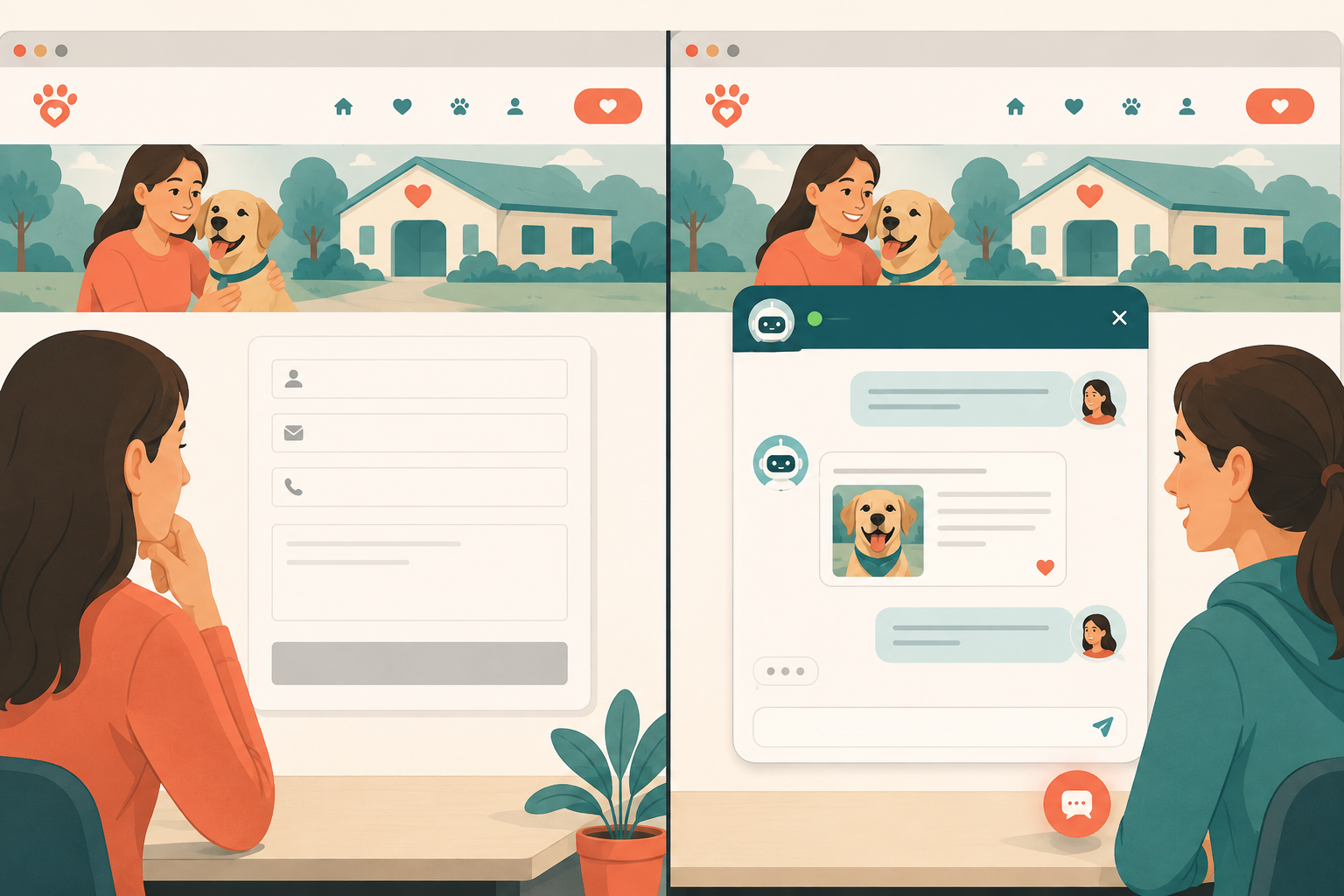
A contact form on a shelter website collects a request and holds it until someone on staff is free to answer. An AI chatbot answers the same visitor in the moment, then passes a qualified lead to your team only when it needs to. That difference in timing is the whole comparison, and for a shelter running on volunteer hours it usually decides whether a potential adopter, foster, or donor ever hears back at all.
For most shelters, an AI chatbot converts more website visitors into adoptions, fosters, and donations than a contact form, because it replies instantly and works after hours when a large share of your traffic actually arrives. A contact form still has a place for structured requests that genuinely need a paper trail, such as formal adoption applications or volunteer agreements. The practical answer is not either-or. It is a chatbot on your high-intent pages for immediate questions, with a form kept only where you need a signed, structured submission.
The core problem: a form only works when someone is watching the inbox
A contact form is a message in a bottle. A visitor types their question, presses submit, and then waits. On a shelter site, the reply depends on whether a staff member or volunteer opens the shared inbox, reads the message, and responds before the person has moved on to another shelter or another rescue.
The friction shows up before the message is even sent. Form abandonment is one of the most consistent problems in web design, and it hits nonprofits harder than most sectors. According to independent form conversion benchmarks, the nonprofit sector has one of the highest form abandonment rates of any industry at 77.9%, second only to airlines. In plain terms, roughly three out of four people who start filling out a nonprofit form never finish it.
That number is worth sitting with. A shelter can drive traffic through social posts, adoption events, and local press, and still lose most of the interested visitors at the exact moment they try to reach out.
Head to head: response time, abandonment, and after-hours coverage
The three factors that matter most for a shelter are how fast the visitor gets a reply, how many visitors give up before completing the interaction, and whether anything happens outside staffed hours. Here is how the two options compare on each.
| Factor | Contact form | AI chatbot |
|---|---|---|
| First response time | Hours to days, depending on inbox monitoring | Instant, on the same page visit |
| After-hours coverage | None until staff return | Continuous, including nights and weekends |
| Abandonment risk | High, worsened by long multi-field forms | Lower, because it asks one question at a time |
| Effort before value | Visitor gives information first, gets nothing back yet | Visitor gets an answer first, shares details after |
| Best fit | Formal applications and signed agreements | Quick questions on adoptions, hours, fostering, donating |
| Staff workload | Every message is triaged and answered by a person | Common questions are handled automatically |
The pattern is consistent. A form front-loads the effort onto the visitor and back-loads the payoff onto your staff. A chatbot reverses both. It answers first, which lowers the reason to abandon, and it absorbs the repetitive questions your team answers dozens of times a week.
Why after-hours coverage is the deciding factor for shelters
Shelter websites do not get most of their traffic during business hours. People browse adoptable animals in the evening after work, on weekends, and late at night when they finally have a quiet moment to think about adding a pet to the household. A contact form submitted at 10 p.m. on a Saturday sits untouched until Monday morning. By then the visitor has often looked elsewhere.
This is where the AI chatbot earns its place. It does not sleep, take weekends, or work a partial volunteer shift. A visitor asking whether a specific dog is still available, what the adoption fee covers, or how fostering works gets an answer at the moment their interest is highest.
What a form still does better
An honest comparison has to name where the form wins. A contact form is the right tool when you need a structured, complete, and recorded submission. Formal adoption applications, volunteer agreements, and foster intake forms all benefit from fixed fields, required questions, and a stored record you can reference later. A chatbot can begin those conversations and hand off a warm lead, but the signed, structured document is still a form’s job.
The mistake is using a form as the front door for every kind of contact. A visitor with a two-minute question does not want to fill out a ten-field form to ask it, and the abandonment data shows they usually will not.
- Adoptable animal profiles: Chatbot. Visitors have quick, specific questions and high intent.
- Homepage and landing pages: Chatbot. Catch questions before the visitor leaves.
- Donate page: Chatbot to answer objections and guide the gift, with your donation form kept for the transaction.
- Formal adoption application: Form. This needs structured, recorded fields.
- Volunteer or foster agreement: Form. A signature and complete record matter here.
- Contact or hours page: Chatbot. Instant answers reduce lost visitors.

Cost, setup, and the real trade-off
A basic contact form is effectively free and already built into most website platforms, which is why nearly every shelter has one. The cost is not on the invoice. It is in the visitors lost to slow replies and the staff hours spent answering the same questions by email.
An AI chatbot has a real cost, whether that is a subscription or setup time, but it shifts the workload. Instead of your team retyping the same answers about hours, fees, and availability, the widget handles them and only escalates when a person is genuinely needed. The trade-off is spending on software to recover the volunteer hours and the interested visitors you are currently losing for free.
For a per-animal chat widget specifically, the added value is that each animal profile becomes its own conversation rather than a static photo and a paragraph. A visitor can ask about that specific dog or cat and get a personality-driven, on-topic answer, which a generic contact form cannot do at all.
How to evaluate a chatbot before you replace anything
You do not need to remove your forms to test this. Add a chatbot to your two or three highest-intent pages, keep your formal application forms exactly where they are, and watch what changes over a month. Look at whether more conversations start, whether after-hours questions are getting answered, and whether staff are spending less time on repetitive email replies. Let the results decide how far you roll it out.
Frequently asked questions
Should a shelter get rid of its contact form entirely?
No. Keep forms for formal applications and signed agreements where a structured, recorded submission matters. Use a chatbot for the quick, high-intent questions that a form tends to lose.
Is an AI chatbot hard to add to an existing shelter website?
Usually not. Most modern chat widgets install as a small embed or plugin without rebuilding the site.
Will a chatbot replace shelter staff?
No. It handles repetitive questions and after-hours coverage, then hands genuine leads to your team. The goal is to free up volunteer and staff hours, not remove the human decisions that adoptions require.
What about visitors who prefer to email?
A chatbot can still collect contact details inside the conversation and pass them along, so people who want a follow-up email get one. The difference is they get an immediate answer first.
Does a chatbot help with donations or only adoptions?
Both. On a donate page it can answer objections, explain where money goes, and guide a hesitant visitor toward giving, while your existing donation form still processes the transaction.
Conclusion
The comparison between an AI chatbot and a contact form comes down to timing and effort. A form asks your visitor to do the work first and then wait, which is why most nonprofit forms are abandoned before they are ever submitted. A chatbot answers first, works when your staff cannot, and reserves human attention for the moments that actually need it. For most shelters the smartest setup is not a choice between the two but a clear division of labor: instant chat where visitors have questions, structured forms where you need a signed record.