The Exact Email Structure That Doubled Repeat Donations in 90 Days
By Herb Locke, Founder of BarkLogue
The Problem With Most Thank-You Emails
Most shelter thank-you emails do one thing. They confirm the transaction.
Amount received. Tax receipt attached. Generic gratitude. Done.
The donor closes the email and forgets they gave within 48 hours. Not because they do not care. Because nothing in that email gave them a reason to stay connected.
The thank-you email is the highest-leverage communication a shelter sends. It arrives at the exact moment a donor feels most connected to your mission. What you do with that moment determines whether they give once or give for years.
The 3-Email Sequence That Works
Email 1: The Thank-You (send within 24 hours)
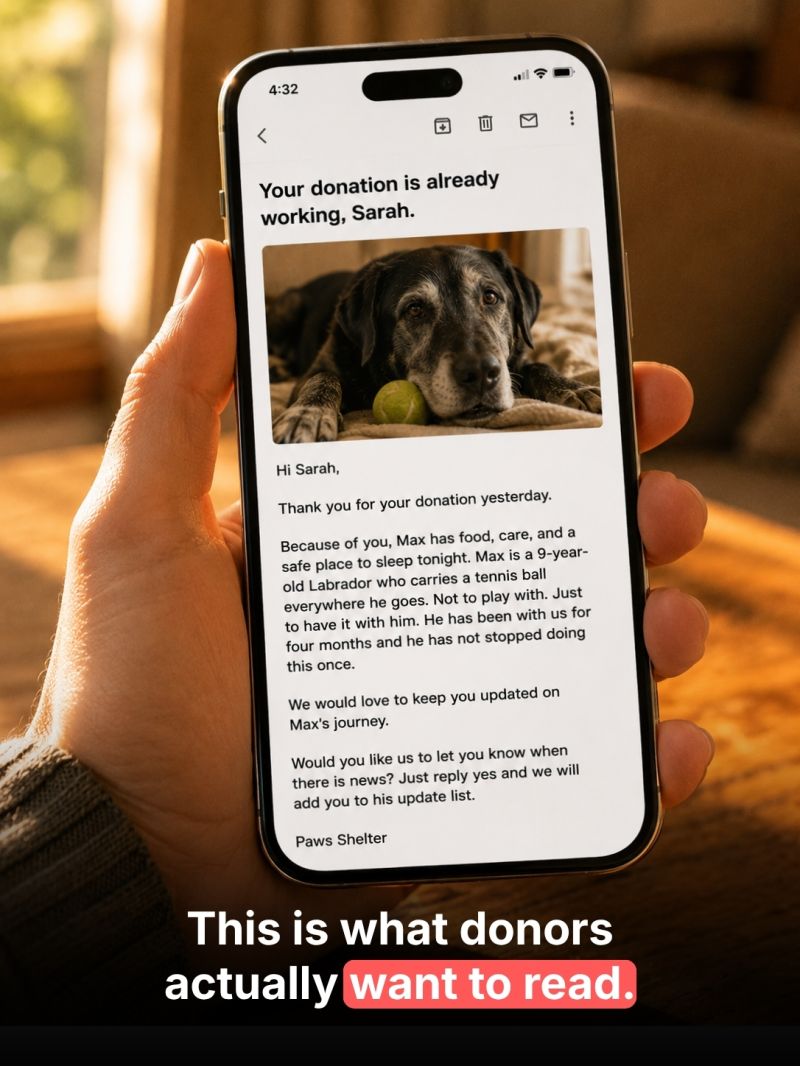
Subject: Your donation is already working, [first name]
Hi [first name],
Thank you for donating to [shelter name] yesterday. It means more than a standard thank-you email can probably convey, so I want to try to be specific about what your support actually did.
Because of you, [animal name] has food, clean water, and a safe place to sleep tonight.
[Animal name] is a [age]-year-old [breed or description] who has been with us for [time]. [Two to three sentences that describe this animal as an individual. Use a specific detail, something they do, something they love, something that makes them memorable. This is the most important part of the email. Do not use generic language here.]
For example: “Max came to us in January. He greets every staff member the same way every morning, ears back, tail going, a tennis ball in his mouth that he has no intention of giving up. He has been here for four months and he has not stopped doing this once.”
That is who your donation helped today.
We would love to keep you updated on [animal name] as their story develops. If you would like to hear news when there is something to share, just reply to this email with the word yes and we will make sure you are the first to know.
No pressure either way. We just know that some people like to follow the story, and we are happy to share it with you if you do.
Thank you again for being here.
[Your name] [Shelter name]
P.S. Your official tax receipt is attached. If you have any questions about it, just reply to this email and we will sort it out.
Email 2: The Update (send within 30 days)
Subject: We promised to update you on [animal name]
Hi [first name],
A few weeks ago you donated to [shelter name] and asked us to keep you updated on [animal name].
Here is where things stand.
[Three to four sentences with a genuine, specific update. If the animal was adopted, tell that story with real detail. Who adopted them, what the moment was like, what the first week looked like if you know. If they are still at the shelter, share something new you have observed about them. A behavior you noticed, a milestone they reached, a moment that stood out. If their situation has changed or become more urgent, be honest about that too. Donors respect honesty far more than they respect carefully managed messaging.]
For example: “Last Tuesday, a family came in specifically because they had read about Max online. Their youngest daughter walked straight to his kennel, sat down on the floor in front of it, and Max put the tennis ball through the fence toward her. The family adopted him that afternoon. He went home with the tennis ball.”
Or: “Max is still with us. He has been here five months now. He started coming to the front of his kennel to greet visitors last week, which he was not doing before. The staff think he is finally starting to trust that people will come back. We are still looking for his person.”
We are not writing to ask you for anything today.
We just wanted to keep our word and let you know.
Thank you for caring enough to ask.
[Your name] [Shelter name]
Email 3: The Soft Ask (send within 60 to 90 days)
Subject: One more update, and someone new we want you to meet
Hi [first name],
We have been keeping you updated on [animal name] and we wanted to share where their story ended up before we introduce someone new.
[One to two sentences with the final outcome for the original animal, or the most recent development if they are still at the shelter.]
We also want you to meet [new animal name].
[New animal name] is a [age]-year-old [breed or description] who arrived at [shelter name] [time] ago. [Three to four sentences describing this animal as an individual. Again, use specific details. A habit, a quirk, a way they interact with people. Make this animal real in the same way you made the first one real. The donor is now primed to connect because they already have a relationship with your shelter through the previous two emails.]
For example: “Daisy came to us in March. She has claimed a specific spot on the blanket in the far left corner of her enclosure and will politely but firmly redirect any other cat who tries to use it. She is seven years old, fully settled in her ways, and completely certain about what she likes. She is still waiting for someone who appreciates a cat that knows her own mind.”
If you would like to help animals like [original animal name] and [new animal name], here is how.
[Direct link to donation page] A monthly gift of any amount, even five or ten dollars, means we can keep giving animals like these the time and care they need to find the right home.
And if you would like to keep following [new animal name]’s story the way you followed [original animal name]’s, just reply and let us know.
Thank you for staying with us. It matters more than you know.
[Your name] [Shelter name]
Why This Works
The sequence works because it treats the donor as a person following a story, not a wallet receiving requests.
Every email delivers something before it asks for anything. The donor builds trust with the shelter through two genuine interactions before they are ever asked to give again.
By the time the ask arrives in Email 3, it does not feel like a campaign. It feels like a natural next step in a relationship that has already been established.
The donors who respond to this sequence are not one-time givers who happened to click a link. They are people who are now emotionally invested in the outcome of a specific animal’s life. That is the foundation of every recurring donor relationship worth having.
The One Change to Make Today
Find your last 30 donors who have not given again in the past six months.
Send them Email 1 right now, even if it has been months since they gave.
Name a specific animal. Add the question at the bottom.
The donors who respond are not lost. They were just waiting for a reason to stay connected.
Created by BarkLogue. Helping shelters turn animal stories into lasting donor relationships. barklogue.com