A shelter director in Saskatchewan said something to me last year that I keep coming back to.
I asked her which donors gave the most to her shelter.
She paused,
then said: “That’s not the right question. The donors who matter most aren’t the biggest givers.
They’re the ones who give every single month.
And most of them started because they knew a dog by name.”
I’d been building BarkLogue for about six months at that point.
I thought I understood the dog shelter fundraising problem. I didn’t. Not fully.
The Real Reason Dog Shelter Fundraising Stalls
Most shelters treat fundraising as an events problem. Not enough walks, washes, or bake sales.
So they plan more events, run more campaigns, and hope the numbers improve.
Sometimes they do, for a week.
But the donors who show up to a dog wash on a Saturday in June are not the same donors who set up a $25 monthly contribution in November.
Those are two completely different relationships.
One is transactional. The other is personal.
The research backs this up.
A study published in the journal Psychological Science found that people give significantly more to a single identified individual than to a group.
Even a large group in greater need.
The researchers called it the identifiable victim effect.
One named dog with a story consistently outperforms a statistic about 200 dogs in need.
Event-first fundraising gets attention.
Story-first fundraising builds the recurring donor relationships that actually sustain a shelter.
What Dog Shelter Fundraising Usually Looks Like (vs. What Works)
Here is the kind of donation appeal I see shelters send out constantly:
Before: “Help us support the 47 dogs currently in our care.
Your donation goes toward food, medical care, and housing for animals waiting for their forever homes. Donate today.”
That appeal is not wrong. It is just invisible. There is no one to root for.
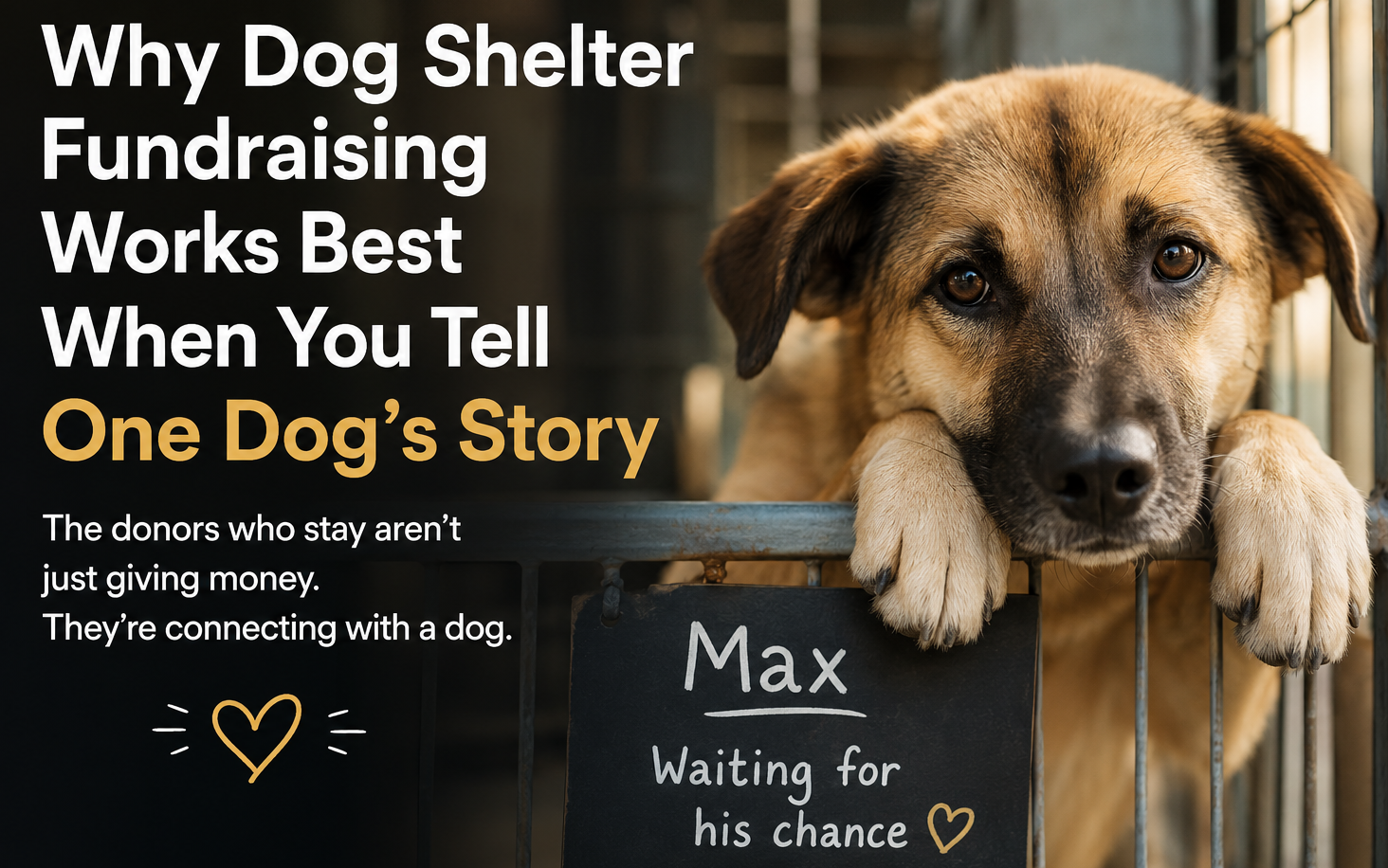
After: “Max has been at the shelter for 214 days. He is a 7-year-old Shepherd mix who sits by the front door every morning and waits.
The staff aren’t sure what he’s waiting for.
But he does it every day. Max needs a dental procedure before he can be adopted. It costs $380. If you can help, here’s how.”
Same cause. Completely different experience for the donor. Max is a real individual. The $380 is a specific problem with a specific solution.
The donor knows exactly what their money does.
This is not a trick. It is not manipulation. It is just telling the truth about one animal clearly enough that a donor can actually feel it.
Three Dog Shelter Fundraising Approaches That Actually Build Donor Relationships
These are not events. They are not campaigns with countdown timers. They are habits that compound over time.
1. Name the dog in every appeal
Not “help the animals.” Not “support our residents.” Max. Luna. Bruno. One name, one story, one ask. A donor who gives because of Max will keep giving because of the next dog they meet through you. That is how recurring donors are made.
2. One story per campaign, not a mass listing
I understand the instinct to show volume. “Look at all the animals who need help.” But volume creates paralysis. When someone sees 47 dogs at once, their brain cannot connect to any of them. When they see Max, they can. Focus is not a compromise. It is the strategy.
3. Send the update
This is the one most shelters skip.
When Max gets adopted, or gets his dental procedure done, or goes home, tell the donors who gave. That one email is worth more to donor retention than any thank-you letter you will ever write. It closes the loop.
It proves their money did something real. And it makes them want to give again.
According to the Association of Fundraising Professionals, donor retention in the nonprofit sector hovers around 45%.
Shelters that build story-based donor communication consistently outperform that average because their donors feel like participants, not ATMs.
The Fear That Stops Most Shelters
If you’re thinking you don’t have time to write an individual story for every dog in your care, you’re right. And you don’t have to.
You need one story per campaign. That is it. Not 47. One.
Pick the dog whose story is easiest to tell right now. The one a volunteer mentioned at your last staff meeting.
The one whose quirk everyone laughs about. Write 150 words about that dog. Ask for something specific. Send it.
That is the whole system at the start.
It gets easier the more you do it. And the results compound in a way that a dog wash on a Saturday simply cannot.
I built BarkLogue because I kept seeing shelters with extraordinary animals and ordinary fundraising results.
The animals were never the problem.
The stories were just not reaching the people who would have given if they had known.
Dog Appeal Checklist
Before You Send It
Dog Appeal Checklist
Run every donation appeal through these 5 questions before publishing.
Does the appeal name one specific dog?
Not “the animals.” One dog. One name. Used more than once.
Is there at least one specific behavioral detail?
Not “friendly.” What does this dog actually do that shows who they are?
Is the ask specific?
Not “any amount helps.” What does $50, $100, or $380 actually pay for, for this dog?
Do you have a plan to send an update?
What happens to this dog next? Who will tell donors? When? The follow-up is where loyalty is built.
Could a stranger read this and know this dog in 60 seconds?
If the answer is no, add one more specific detail. Then read it again.
FAQ
How do I start dog shelter fundraising if we have no donor list?
Start with one story and one channel. Post about a specific dog on your shelter’s social media page. Ask your staff and volunteers to share it personally. The first donor list you build will come from people who already care, friends of staff, local community members. You do not need a large list. You need one real story.
Should we still run fundraising events?
Yes. Events bring in new people and build community awareness. But treat them as the beginning of a relationship, not the fundraising strategy itself. The goal of a dog wash or walk-a-thon is to introduce your shelter to people who might become story-connected donors later. Events fill the top of the funnel. Stories convert and retain.
How do we write a dog profile that actually gets donations?
Answer three questions: What does this dog do that nobody else does? What almost happened to them? What does the right person get by adopting or supporting them? Skip physical descriptions. Focus on behavior and personality. For a fuller guide, read our animal profile writing guide on how to write listings that connect with donors.
What is the fastest way to improve our fundraising results this month?
Send one story-based appeal for one named dog this week. Keep it under 200 words. Include a specific ask tied to a real need. Then schedule the follow-up update before you hit send. That one change, from a general appeal to a named story with a specific ask, is where the difference starts.
How do recurring donations work for animal shelters?
Recurring donors set up automatic monthly contributions, usually $10 to $50. They convert at higher rates when they feel a personal connection to the animals. The research on donor retention from the Association of Fundraising Professionals shows that emotional connection, not incentives, is the strongest driver of recurring giving. One named animal story is more effective than a discount or a thank-you gift.
What do donors actually want to hear from us?
They want to know what happened. Not statistics. Not operational updates. Not budget reports. They want to know if the dog they gave to found a home. If the cat they read about is doing better. The update is the most underused tool in animal shelter fundraising. Send it. Every time.
What to Do Next
Pick one dog in your shelter right now. Write down three specific things about that dog that are not physical descriptions.
What does the dog do every morning?
What is the one thing the staff knows about this animal that the adoption listing does not say?
What would the right person love about them?
That is your next donor appeal. It does not need to be long. It needs to be true and specific.
If you want to see how BarkLogue helps shelters tell those stories at scale, book 30 minutes at calendly.com/blang-barklogue/30min. No pitch. Just answers.
Herb Locke is the founder of BarkLogue, an AI platform that gives shelter animals a voice and helps shelters raise more donations. He spent 25 years building and selling businesses before pivoting entirely to animal welfare. You can learn more at barklogue.com.