A shelter director in Ohio told me something that stopped me cold.
She’d run 4 events, sent 12 email campaigns, posted on social three times a week – and her donor retention rate was still 28%.
She looked genuinely defeated.
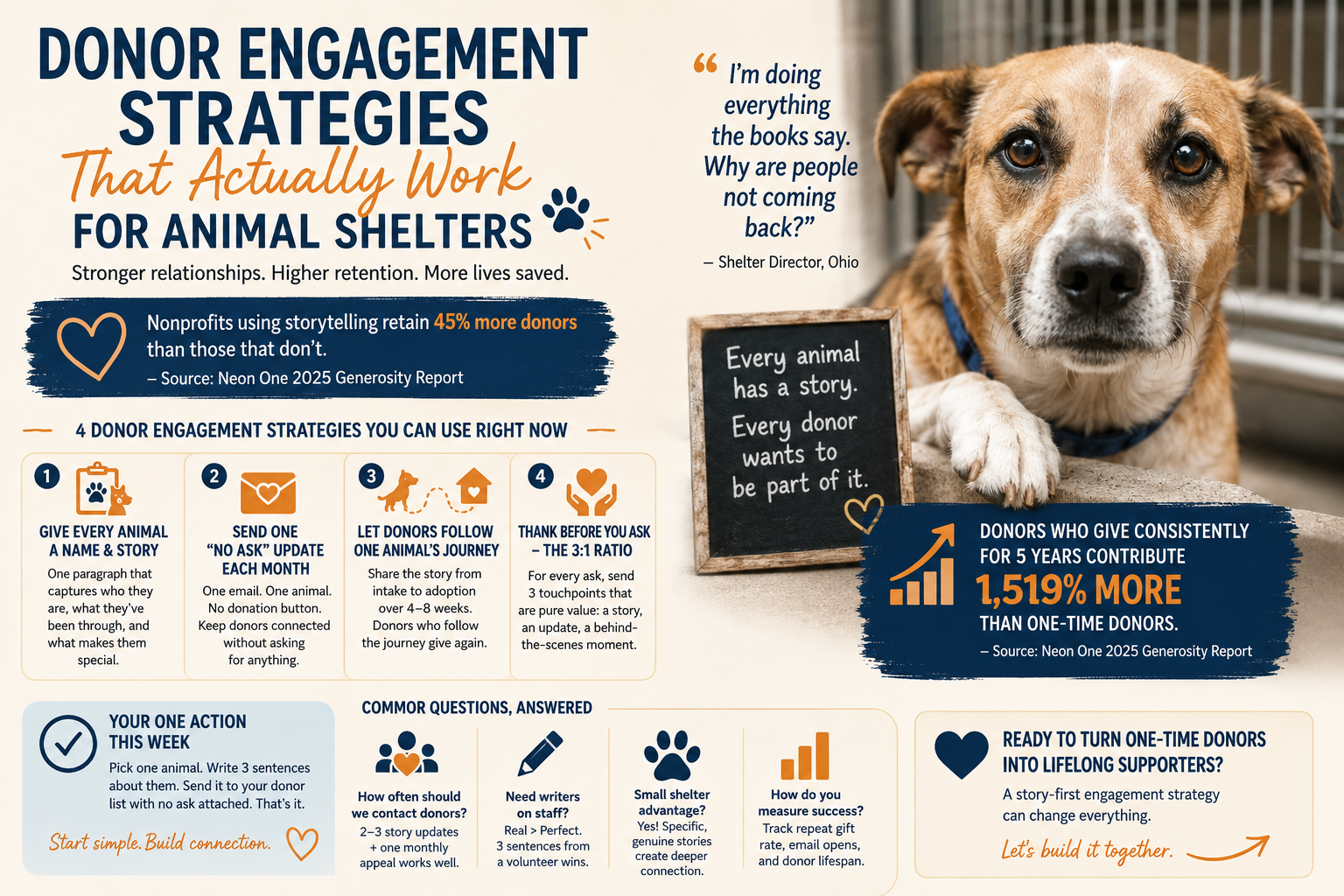
“I’m doing everything the books say. Why are people not coming back?”
I’ve heard that exact story from shelter operators across the country. And I finally figured out why it keeps happening.
Why Most Donor Engagement Strategies Miss the Point
Most donor engagement strategies are built around asking, not connecting.
Events, emails, social posts – those are tools, not relationships.
Think about friendship.
You don’t become close with someone because they show up in your inbox every month asking for something.
Donors work the same way.
If every communication is a transaction, you’re not building a relationship – you’re just asking strangers for money until they stop opening your emails.
What I Saw Visiting Shelters Across the Country
I visited 11 shelters across 6 states while building BarkLogue – the AI platform that gives shelter animals a voice.
I wanted to understand what actually worked before I built anything.
The shelters with the strongest donor relationships all shared one thing.
They told individual animal stories – named animals, specific details, real moments.
Not “we rescued 400 animals last year.” Stories.
One shelter in Tennessee had a donor named Carol giving $200 a year for nine years.
She kept coming back because of a senior beagle named Rupert – and the updates they kept sending her until he found his home.
The Donor Engagement Strategy That Outperforms Everything Else
Individual animal stories are the most powerful donor engagement strategy a shelter can use. Full stop.
Nonprofits using storytelling retain 45% more donors than those that don’t.
And donors who give consistently for five years contribute 1,519% more than one-time donors, according to Neon One’s 2025 Generosity Report.
Long-term donors aren’t found through better ad targeting.
They’re built through consistent, personal connection.
The Mistake I See Most Shelters Make
Asking for money before earning trust. That’s it.
Before: A donor gives once. The next email is another ask. Then another. They unsubscribe.
After: A donor gives once. They get a thank-you tied to a specific animal.
Two weeks later, a short update – no ask, just a moment. Next time you reach out for a donation, they say yes.
If you’re worried this takes too much time, here’s the truth: a 3-sentence animal update takes 8 minutes to write.
You don’t need a marketing team – you just need a little consistency.
Four Donor Engagement Strategies You Can Use Right Now
1. Give every animal a name and a one-paragraph story. Not a medical chart. A real description – what they’re like, what they’ve been through, what makes them.
2. Send one “no ask” update per month. One email. One animal. No donation button. Donors who receive these are far more likely to give when you do ask – because they feel like insiders, not ATMs.
3. Let donors follow one animal from intake to adoption. Share the journey over 4–8 weeks. Intake day, first playdate, going home.
Donors who follow a journey like this almost always give again.
4. Thank before you ask – the 3:1 ratio. For every donation ask, send 3 touchpoints that are pure value: a story, an update, a behind-the-scenes moment.
This ratio changed everything for every shelter I saw try it.
What I’m Building Because of This
Every shelter visit shaped what BarkLogue became. The problem wasn’t that staff didn’t care about stories – they cared deeply.
The problem was telling individual animal stories consistently across 40, 80, 200 animals at a time was just too hard manually.
BarkLogue makes it easy to give every animal a voice, automatically. That’s the whole idea.
You Can Apply This Starting This Week
Your one action right now: pick one animal in your shelter and write 3 sentences about them – their name, one thing that makes them memorable, and where they’re at in their journey.
Send it to your donor list with no ask attached. That’s it.
You don’t need a six-month plan to start. Every shelter I’ve seen turn their retention around started exactly here.
Common Questions About Donor Engagement Strategies
How often should shelters contact donors? More than most shelters do – but only when it’s not always an ask. A mix of 2–3 story updates and one monthly appeal works well for most shelters.
What if we don’t have writers on staff? You don’t need a writer. A 3-sentence update from a volunteer who spent the afternoon with a dog beats a polished newsletter every time. Real beats perfect.
Does this work for smaller shelters with fewer animals? Smaller shelters actually have an advantage. Fewer animals means you can tell each story more deeply – and donors connect with that specificity.
FAQ
What is donor engagement for animal shelters?
It’s how shelters build real relationships with the people who support them financially. Good donor engagement keeps donors connected to the animals and outcomes their gifts make possible – not just to a donation page.
Why do donors stop giving to shelters?
Most stop because they feel forgotten, not because they stopped caring. If the only communication they receive is an ask, they disengage. Consistent personal updates dramatically reduce donor dropout.
How do animal stories improve donor retention?
Stories create emotional connection. Nonprofits using storytelling retain 45% more donors than those relying on stats and appeals alone.
What’s the biggest mistake shelters make with donors?
Asking before earning trust. Leading with a donation ask before a donor feels connected is the fastest way to lose them. Relationship first – the ask follows naturally.
How do you measure donor engagement?
Track email open rates, repeat gift rate, and average donor lifespan. The single most important number: what percentage of donors give again in year two?
Can small shelters compete with larger ones for donor attention?
Yes – and they often win. A genuine 4-sentence story from a small shelter will outperform a polished video from a large organization if it feels real. Authenticity is the advantage every shelter already has.
What to Do Next
If you run a shelter and you’re tired of watching donors give once and disappear, let’s talk about what a story-first engagement strategy looks like for your organization.