A shelter director called me a few months ago.
She’d just upgraded their donor retention software- new CRM, automated receipts, segmented lists.
Donors were still disappearing after their first gift.
I asked her one thing: “What do donors hear from you after they give?”
Long pause. “A tax receipt.”
There’s the problem and it has nothing to do with the software.
Why Donor Retention Software Isn’t Enough
Only 46.6% of nonprofit donors gave again in 2023, according to Dataro’s 2024 analysis. First-time donors? Only 7% come back in year one.
That’s not a software problem. That’s a relationship problem.
Think about any friendship.
You meet someone, have a great conversation, feel a real connection- and then they never reach out again.
That’s what most shelters do to donors.
Someone gives $50.
They get a receipt. Then silence.
Six months later, an appeal lands in their inbox and they have no idea who you are.
Donor retention software tracks your relationships. It can’t create them.
What Good Software Actually Does
A solid CRM logs every interaction, automates follow-up timing, flags lapsing donors, and makes recurring giving easy.
For a small shelter team stretched thin, that’s genuinely useful.
But automation delivers whatever you put into it.
Send a generic thank-you on loop and you’ve automated forgetting.
Think of it like a postal system.
The best mail carrier in the world can’t save a boring letter.
The Pattern I Keep Seeing
I’ve visited a lot of shelters.
Almost every time, same story: a $400/month CRM fed nothing but receipts and year-end appeals.
The software is doing its job. The content isn’t.
Here’s what the difference looks like:
Before: Donor gives $75. Gets a receipt. Gets a December appeal. Maybe gives again.
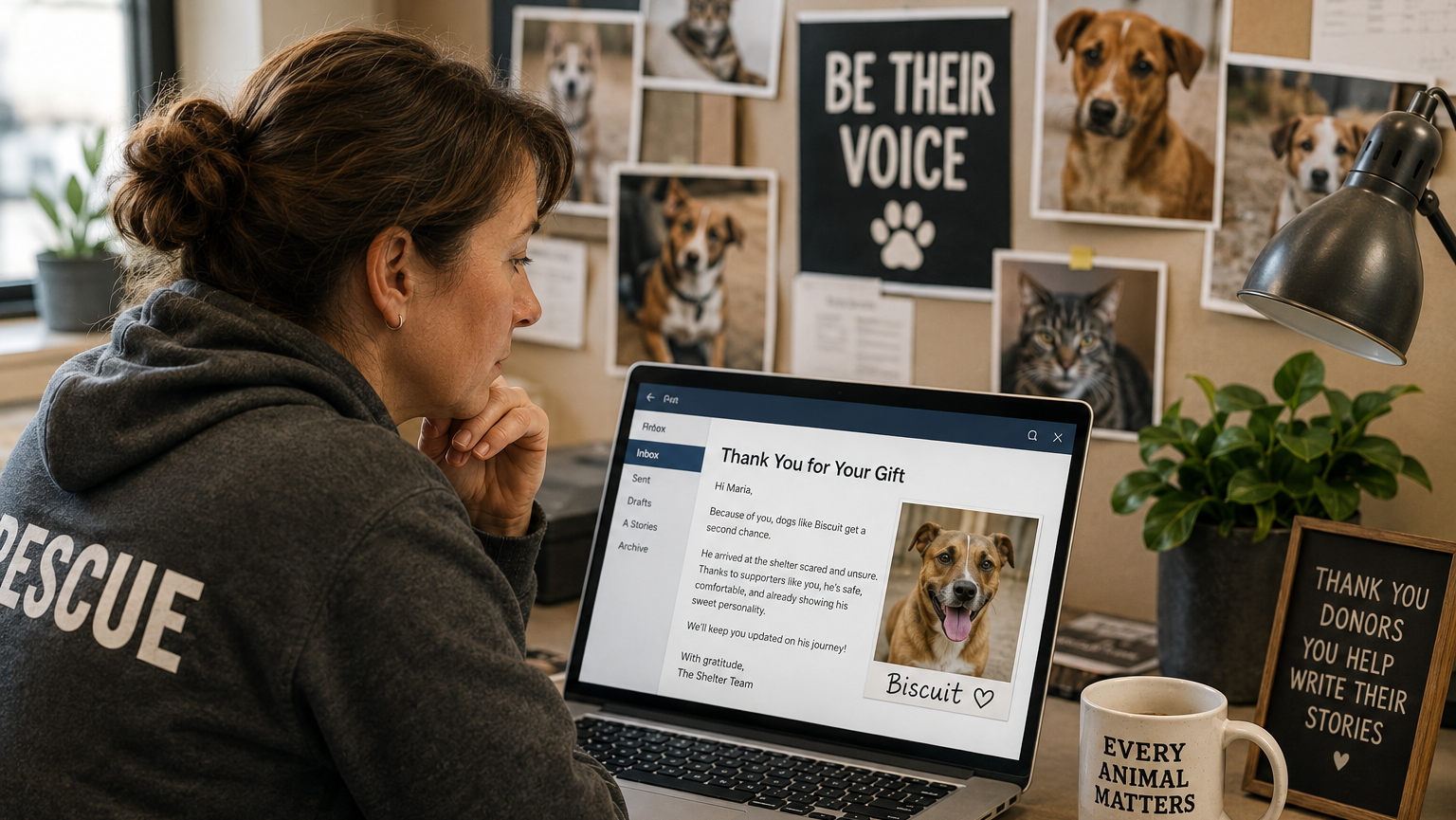
After: Donor gives $75. Gets a receipt plus a short note about a dog named Biscuit who just arrived.
Three weeks later- Biscuit found a home.
In January, another animal update.
Donor gives again in February. Nobody asked.
The difference isn’t the software. It’s Biscuit.
What Actually Keeps Donors Coming Back
Donors stay when they feel like insiders – part of a real story, not a mailing list.
Repeat donors now make up over 60% of total nonprofit fundraising dollars, per the Fundraising Effectiveness Project.
You want those people. Stories are how you keep them.
I hear this from shelter directors: “We don’t have time to write stories.”
I get it – you’re short-staffed and the animals don’t wait.
But a two-paragraph update about one animal takes ten minutes. That’s what moves people.
If you’re worried storytelling takes too long – it doesn’t. One animal. A name, two details, an outcome.
Done.
The Combo That Actually Works
Your CRM handles timing and delivery.
It reminds you when someone hasn’t given in 90 days.
It makes monthly giving easy.
Those are real wins – keep them but what it sends is your job.
Animal stories are your highest-leverage content.
A donor who knows Biscuit doesn’t need to be “retained.” They already want to come back.
At BarkLogue, that’s exactly what we built – an AI platform that gives every shelter animal a voice.
so that voice reaches donors automatically.
Real individual stories, ready to send. The kind of update donors forward to friends.
You don’t need an expensive stack to start.
A simple CRM like Little Green Light or Bloomerang, paired with monthly animal updates, will outperform a $500/month platform with nothing real to say.
Your One Action Right Now
Pull up your last five donor emails. Count how many feature a specific animal by name.
If the answer is zero – that’s where to start. Don’t redesign your whole strategy.
Just add one animal story to your next email. See what happens to your reply rate.
If you want to build this into a real system, let’ talk.
If You’re a Donor
You’ve probably gotten a generic receipt from an org you cared about – and slowly stopped thinking about them. Not because you stopped caring.
Because they stopped making you feel connected.
When a shelter tells you real animal stories, share them. That signals they’re doing something right.
Common Questions
What is donor retention software?
A CRM or fundraising platform that tracks donors, automates follow-up, and manages recurring giving. It organizes your relationships. It doesn’t build them for you.
What’s a good donor retention rate for shelters?
Sector average is 45–55%. Top performers hit close to 70%. For small shelters, 50% consistent retention is a strong, realistic goal – and story-based communication is the clearest path there.
Why do donors stop giving?
They feel forgotten. The #1 reason donors leave nonprofits: they never felt connected to the impact of their gift. It’s rarely the cause. It’s the communication.
Does storytelling actually improve retention?
Yes. Donors who get regular animal story updates give more often and stay longer. The emotional connection to a specific animal – their name, their arc, their outcome – is something no automated campaign can fake.
What’s the simplest setup for a small shelter?
A basic CRM (Little Green Light or Bloomerang both have affordable tiers) plus one animal story email per month. That’s it. Add from there.
How does BarkLogue help?
BarkLogue generates real individual animal stories for your shelter – ready to drop into donor emails. Less time writing, more consistent connection with the people who give.
What Should You Do Next?
Ask yourself this about your last donor email: “Would I keep reading this if I didn’t already care?”
If no – add one animal story before you send the next one.
One animal. A name, a detail, a moment. That’s the thing donor retention software can never do for you.
Read more on the BarkLogue blog about how shelters are using animal stories to raise more and keep donors longer.