Most chatbots on animal shelter websites answer the same five questions for every visitor. Hours, address, how to apply, volunteer info, donation link. That is useful. It is not what the visitor who has already decided she wants a specific three-year-old beagle actually needs.
The gap between a generic site chatbot and an interactive pet profile AI chatbot is not a feature gap. It is a conversion gap. A visitor who has bonded with a specific animal profile is the highest-intent visitor on your site. The question is whether your chatbot is equipped to serve that specific conversation or whether it routes her back to a FAQ page she has already read.
Quick Answer
An interactive pet profile AI chatbot is embedded within or alongside a specific animal’s profile page. It answers questions about that individual animal, not the shelter generally. This distinction matters because visitors engaging with an individual animal profile have already passed the awareness stage and are in active evaluation. A generic site chatbot treats them the same as a first-time visitor who has never heard of your organization. A per-animal chatbot meets them where they actually are.
Generic Site Bot vs. Per-Animal Chat: What Is Actually Different
A generic site chatbot is configured once, at the domain level. It knows your organization’s name, your hours, your address, your adoption process, and a set of FAQs your team built when you launched it. Every visitor gets the same bot with the same knowledge base.
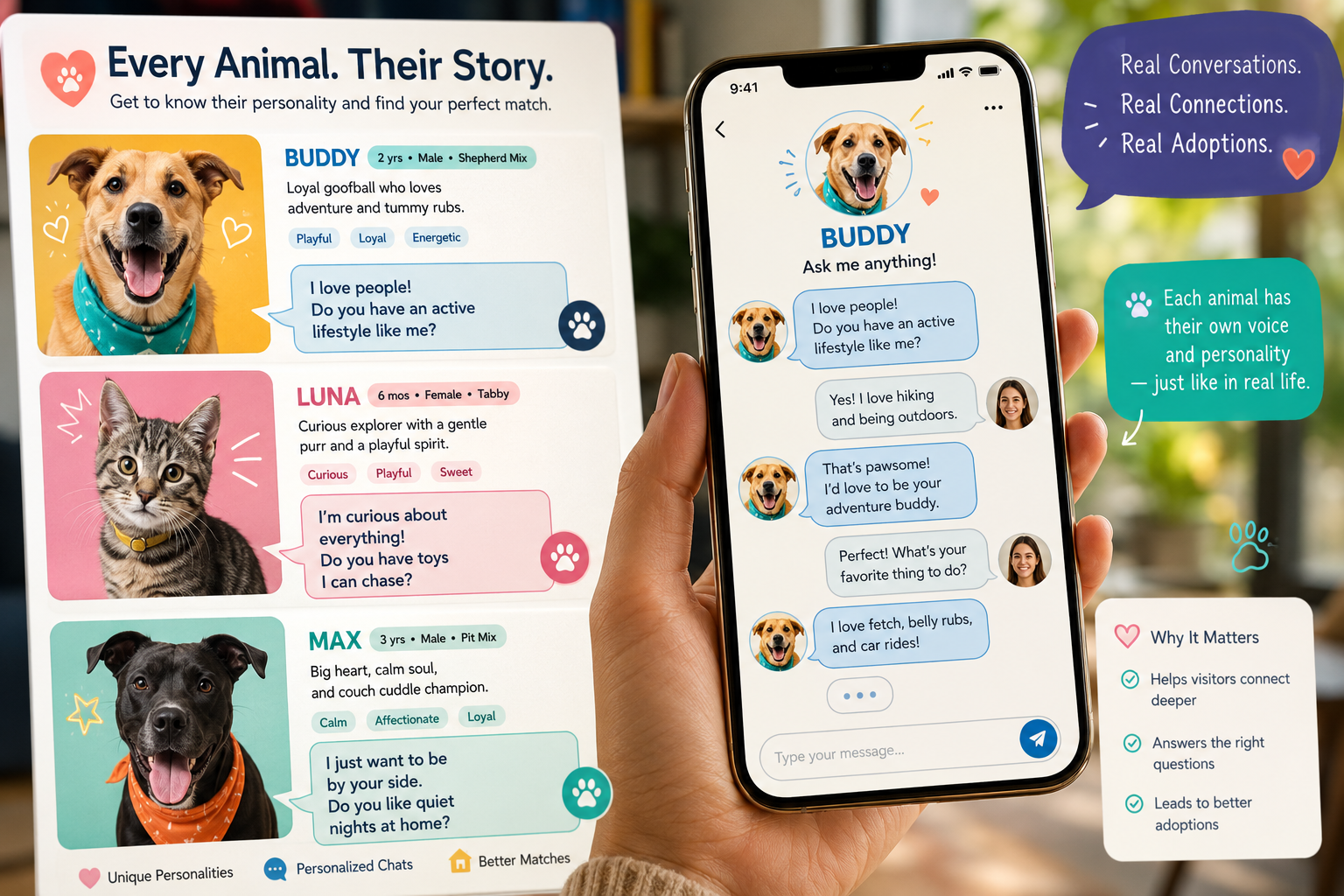
A per-animal interactive chatbot is configured at the profile level. It knows the specific animal: name, age, breed, personality traits, medical history notes, adoption requirements, known behavioral quirks, what kind of home the animal does well in, and what the adoption process looks like for that specific animal if it differs from your standard process.
The difference in visitor experience is significant. A visitor who clicks “Chat with Biscuit” and asks “Is Biscuit good with kids?” gets an accurate, specific answer. A visitor who clicks a generic chat widget and asks the same question gets told to call the shelter or visit the adoption page.
One of those conversations moves toward an adoption appointment. The other one ends the session.
The Visitor Journey from Profile to Inquiry
When a potential adopter lands on an animal profile page, the behavioral pattern is different from a general site visit. They came from a specific search, a Petfinder listing, a social media share, or a direct link someone sent them.
They are not browsing. They are evaluating.
At this stage, the questions they have are about the specific animal: how does Biscuit behave during walks, has she been in a home with cats before, what is the adoption fee for a dog her age, can she be left alone for eight hours, does she have any medical needs the adopter would be responsible for.
A site-level chatbot cannot answer most of these questions accurately because it was not configured with this animal’s profile data. A per-animal chatbot is built around exactly that data.
The result is that per-animal chat shortens the time from profile view to adoption inquiry. The visitor gets answers without calling the shelter, without submitting a form that may not be answered for 24 hours, and without leaving the page. That is the conversion mechanism.
Why This Matters More for Rescues Than Traditional Shelters
Rescue organizations with rotating animal rosters face a compounded version of this problem.
Traditional shelters have relatively stable populations, at least over the course of a week. Rescues, particularly those that pull from high-intake municipal shelters, may turn over a significant portion of their available animals every two to four weeks.
When a rescue’s animal roster changes that quickly, a static FAQ chatbot becomes outdated almost immediately. The animals listed on the website on Monday are not necessarily the animals available by Friday. A visitor who engages with a per-animal chatbot is engaging with a live data source, not a snapshot. The conversation stays accurate to the current state of that animal’s placement status.
There is also the foster-based dynamic. Many rescues have animals in foster homes rather than in a central facility. A visitor asking “Can I come meet Mango this weekend?” gets a meaningfully different answer if the chatbot knows Mango is in a foster home in a specific neighborhood versus at a central adoption event location.
That level of specificity is not possible with a generic site chatbot.
Conversion Data
3x
Businesses using AI chatbots convert website visitors at three times the rate of those relying on static forms alone. Separately, websites deploying AI chatbots have seen conversion rates increase by 23% versus those without. Sources: MasterOfCode Chatbot Statistics (2026); GetPulseChat Conversion Data
These figures come from general e-commerce and SaaS contexts. The underlying mechanism is the same for shelter adoptions: a visitor who receives an accurate, immediate, personalized answer to a specific question is more likely to take the next step than a visitor who is redirected to a static page or asked to call during business hours.

See how BarkLogue builds a per-animal interactive chatbot directly into each shelter animal’s profile page.
Book a Demo CallWhat to Look For in a Per-Animal Chatbot Platform
Profile data integration. The chatbot should pull information from the same source your animal profiles are built from, whether that is your shelter management system, your website CMS, or a direct API connection to a listing service. If the chatbot requires you to manually re-enter animal data into a separate system, any discrepancy between that copy and the live profile becomes a liability.
Personality and behavioral context. An animal profile that lists age, breed, and weight is a record. A per-animal chatbot that can engage with a visitor about that animal’s specific behaviors, known preferences, and home requirements is a conversation. The platform should support structured behavioral fields that feed directly into the chatbot’s responses.
Update and status handling. When an animal is adopted, placed in a foster home, or temporarily unavailable, the chatbot on that animal’s profile needs to reflect that status. A platform that does not handle status changes gracefully will serve visitors inaccurate information, which costs more in trust than it gains in engagement.
Adoption inquiry routing. The chatbot’s job is to move an interested visitor toward a concrete next step: an adoption application, a meet-and-greet appointment, or a direct connection with the staff member managing that animal’s placement. Platforms that end the conversation with a static link to a contact form are less effective than those that route the inquiry directly into a scheduling workflow.
Checklist: Evaluating a Per-Animal Interactive Chat Platform
Data and integration
- Does the chatbot pull profile data from your existing animal management system?
- How often does data sync? Real time or scheduled?
- What happens to the chatbot when an animal is adopted or transferred?
Conversation quality
- Can the chatbot respond to behavioral questions with animal-specific answers, not generic breed information?
- Does the platform allow you to add custom behavioral notes beyond standard profile fields?
- Can you configure different conversation flows for different animal types (dog, cat, small animal)?
Visitor experience
- Is the chatbot embedded on the animal’s profile page, or does it open a separate widget with no animal context?
- Does it load without slowing down the profile page’s core web vitals?
- Is it mobile-native? Most shelter profile traffic comes from mobile devices.
Escalation and handoff
- When a visitor is ready to apply or schedule a visit, where does the chatbot send them?
- Can it push notifications to the staff member responsible for that animal?
- Is there an after-hours mode that collects visitor contact information for follow-up?
FAQ: Interactive Pet Profile AI Chatbots
Is a per-animal chatbot the same as a chatbot that recommends pets based on a quiz?
No. A recommendation quiz chatbot asks a visitor questions to suggest which animals they might like. A per-animal chatbot is embedded within a specific animal’s profile and answers questions about that specific animal. They serve different stages of the adoption journey and can coexist on the same website.
How is this different from just having a detailed animal profile page?
A detailed profile page is static. A per-animal chatbot is interactive. The difference is that a visitor can ask a question the profile page did not anticipate and receive an answer specific to that animal, rather than navigating away to find it or abandoning the page.
Does every animal profile need its own separate chatbot?
No. Per-animal chatbot platforms typically deploy one instance of the chatbot product across all profiles, with the chatbot dynamically loading each animal’s specific data based on which profile page the visitor is currently viewing.
What data should each animal’s chatbot know?
At minimum: name, age, breed, sex, spay/neuter status, adoption fee, behavioral summary, household compatibility (children, other dogs, cats), medical needs, and adoption process specifics for that animal. Platforms differ in how much custom data they allow.
Can a per-animal chatbot handle donation conversations too?
Technically yes, but the visitor intent on a per-animal profile page is adoption-focused. Introducing a donation ask in the same conversation can dilute the primary goal. Most organizations are better served by keeping donation-focused chatbot flows on a separate donations page.
Conclusion
The distinction between a generic site chatbot and an interactive per-animal chatbot is not subtle when you follow a visitor through the adoption journey. The visitor who has already identified a specific animal is your highest-value conversion opportunity. Routing that visitor back to generic FAQs is a measurable cost, not just a missed opportunity.
Per-animal chat works because it matches the specificity of the visitor’s intent. The evaluation question for shelter operators is not “should we have a chatbot?” but “does our chatbot meet visitors where they actually are in the adoption decision?”