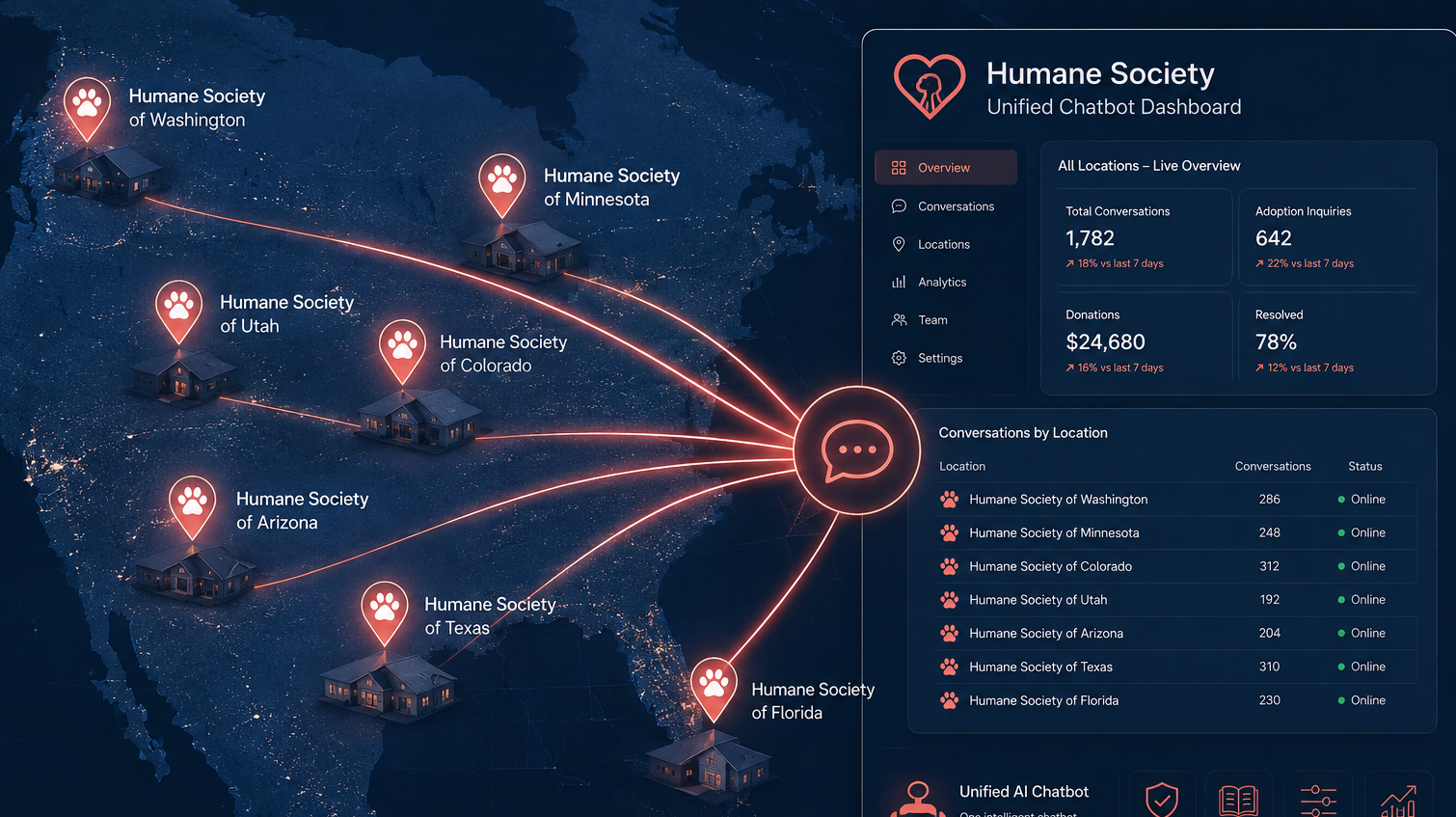
A shelter operating three campuses in the same metro area does not have the same chatbot problem as a single-site rescue with 40 animals. The technology category is the same. The actual requirements are not.
This matters specifically for Humane Society-branded organizations, which are often larger, multi-location, and affiliated with regional networks in ways that generic shelter chatbot guides never address.
Quick Answer
An AI chatbot for a Humane Society shelter needs to handle visitor questions across multiple physical locations, manage animal profiles that move between campuses, and maintain consistent messaging regardless of which site a donor or adopter lands on. Most single-site chatbot products are not built for this. The evaluation checklist is different, and so are the questions you need to ask vendors before signing a contract.
Why “Humane Society” Means Something Different Operationally
The Humane Society name appears on hundreds of independent animal welfare organizations across the United States. Each one is its own entity. There is no national parent organization that controls operations, shares a database, or deploys technology on behalf of local chapters.
What this means for a buyer: if you run or work at a Humane Society, you are making this chatbot decision yourself, without a vendor pre-selected for you at the network level. You are also likely doing it with a larger footprint, a more complex animal database, and more staff touchpoints than the typical single-location rescue the chatbot market tends to assume.
The San Diego Humane Society, for example, operates multiple shelter campuses across San Diego County. Animal Humane Society serves the Minneapolis-St. Paul area across several locations. The Peninsula Humane Society in San Mateo County has both a main campus and satellite adoption centers.
These are fundamentally different operating contexts than a 30-volunteer foster-based rescue.
What a Multi-Campus Shelter Needs That a Single-Site Does Not
Location-aware routing. A visitor who asks “Do you have a black lab available?” needs to know which campus has that dog, not just that one exists. A chatbot that returns a generic “yes, we have dogs” response and links to a static page will not convert that inquiry into an adoption visit. The chatbot needs to either know which animals are at which location or route the question to a staff member who does.
Consistent messaging across entry points. If your campuses each have separate websites, or if your organization’s main website gets traffic for multiple location-specific searches, the chatbot installed on each page needs to answer with the same tone, the same CTA, and the same booking flow. A misconfigured chatbot on a secondary campus page that gives conflicting adoption process information creates real operational problems.
Cross-campus animal transfers. Animals move between shelter locations regularly, particularly during intake surges, medical events, and capacity redistribution. A chatbot that surfaces individual animal profiles needs a data source that reflects those moves in close to real time. Static profile pages that are updated weekly will produce adoption inquiries for animals no longer at the expected location.
Staff coverage across shifts and sites. A chatbot at a single site can escalate to one on-call staff member. A multi-location organization needs to define escalation clearly by campus, by role, and by time of day. Chatbot vendors who sell primarily to small shelters often have no feature for this.
The Animal Transfer Problem Is Underestimated
The most common failure mode for Humane Society chatbots is not the chatbot itself. It is the data behind it.
When a potential adopter engages with a per-animal chatbot and asks about a specific dog, that inquiry is only useful if the profile reflects where that dog actually is, what its current medical clearance status is, and whether it is currently available for adoption appointments.
Most shelter databases update on a lag. Most chatbot integrations reflect whatever state the website last synced from. When an animal has been transferred, treated, or placed in a foster home since the last sync, the chatbot gives the visitor an accurate answer to an outdated question.
This is a data infrastructure problem as much as it is a chatbot problem. Before selecting any AI chat platform, a multi-location Humane Society needs to know: how frequently does this chatbot pull animal data, from which source, and what happens when a profile goes out of date?
By the Numbers
90%
reduction in reporting time achieved by American Humane Society after implementing Box AI across its programs. Staff time previously spent compiling data manually was redirected to direct animal welfare work. Source: Box Blog, December 2025
This figure is not about a chatbot. It is about what happens when an organization operating at the scale and complexity of a major Humane Society network starts applying AI to its administrative overhead. The pattern is consistent: larger animal welfare organizations have more to gain from AI automation, and proportionally more capacity to absorb the implementation work.
The Volunteer and Donor Experience Across Locations
Donors who give to a Humane Society organization often think of it as a single entity, even when it operates multiple campuses. When a donor visits your main website and a chatbot greets them, they expect the bot to know that “your” organization includes all your locations.
The same is true for volunteers. A volunteer who wants to sign up to walk dogs needs to know which campus has availability this Saturday. A chatbot that can only answer with “visit our volunteer page” is not solving the question.
This is where per-animal and per-location profile data, fed into the chatbot at the time of inquiry, produces a meaningfully different result than a generic site bot answering from static FAQ content.

Running multiple shelter locations? See how BarkLogue handles per-animal chat across a multi-campus setup.
Book a Demo CallChecklist: What Multi-Location Humane Society Shelters Should Evaluate
Before signing with any chatbot vendor, confirm the following:
Animal data integration
- Does the chatbot pull live data from your shelter management software, or does it rely on manual profile uploads?
- How often does the integration sync? Real time, hourly, or daily?
- What happens when an animal is transferred between locations between syncs?
Location routing
- Can the chatbot differentiate between animals at Campus A versus Campus B?
- Can it route adoption inquiries to the correct location’s booking flow?
- Does it handle “nearest location” queries if a visitor is coming from outside your primary service area?
Staff escalation
- Can escalation paths be configured by campus, by role, and by time of day?
- What does the handoff look like when a staff member needs to take over from the bot mid-conversation?
Consistency across pages
- If you install the chatbot on multiple subdomains or campaign landing pages, is the configuration centrally managed?
- Can you push messaging updates (seasonal campaigns, adoption events, fee waivers) to all instances simultaneously?
Reporting
- Does the platform give you inquiry volume by location, not just by organization total?
- Can you see which animal profiles generate the most chat sessions?
FAQ: AI Chatbots for Humane Society Shelters
Can one chatbot handle all my shelter locations at once?
It depends on the platform. Some chatbot products support multiple “bots” under a single account, each configured for a specific location. Others deploy a single instance that you configure to handle location-specific routing. Ask vendors specifically how they handle multi-campus deployments before committing.
Do I need a separate chatbot for my donation page versus my adoption page?
Not necessarily, but the conversation flows will need to be different. A visitor arriving from a donation campaign is in a different mindset than one browsing available animals. Platforms that allow you to configure context-specific flows based on page URL are more flexible for multi-purpose organizations.
What shelter management software does a chatbot typically integrate with?
The integrations available vary significantly by vendor. Common shelter software includes Shelterluv, Chameleon, and Pawlytics. Ask any chatbot vendor for a current integration list and confirm whether the integration is native or requires a middleware connector.
How do I handle chatbot conversations about animals that have already been adopted?
A well-integrated chatbot will remove or update an animal’s profile automatically when adoption status changes in your shelter database. If the integration is manual or infrequent, you will need a process for flagging recently-adopted animals to avoid disappointing inquiries.
Is a chatbot appropriate for Humane Society organizations that handle animal control contracts?
Animal control operations introduce legal and liability dimensions that consumer-facing chatbots are generally not designed for. A chatbot deployed on a public-facing adoption site is appropriate. Using the same chatbot to handle animal control surrender or bite-report inquiries requires legal review of your liability exposure first.
Conclusion
Multi-location Humane Society shelters face a chatbot evaluation problem that most vendor demos never address. The demos are built for the single-site use case. The questions that matter most for a three-campus organization, which are data sync frequency, per-location routing, escalation by site, and centralized management, are typically only surfaced when you push the vendor past the standard pitch.
The organizations that deploy AI chat successfully at scale are the ones who define their operational requirements before they start vendor conversations. For a Humane Society shelter, that means mapping your animal data flow, your campus structure, and your staff escalation chain before you look at a product demo.