The shelter director who told me she was “just going to try a chatbot” had already paid for three different software tools that year. She was not evaluating the chatbot carefully. She was hoping. That is understandable. When you are short-staffed and your inquiry volume is climbing, you will try things. But an AI chatbot for animal shelters is not a catch-all fix, and buying one without understanding what it actually does will not help you. Here is what it does, what it does not do, and the three questions you need answered before you spend anything.
Quick Answer
An AI chatbot for animal shelters answers visitor questions about specific animals, the adoption process, foster programs, volunteer opportunities, and shelter hours – without requiring a staff member to respond in real time. What it does not do is manage your animal database, process applications, or replace the human judgment required at any step of the adoption decision. The value is in the gap between when a visitor has a question and when staff are available to answer it.
What an AI Chatbot for Animal Shelters Actually Does
Shelter Animals Count reported 4.2 million dogs and cats adopted in the United States in 2025 – a 1% year-over-year increase. For shelters trying to move more animals out the door, the question is not whether adoption numbers are growing. It is where the process breaks down for the visitors who want to adopt but do not complete it. An AI chatbot addresses a specific part of that breakdown: the moment a visitor has a question and no one is there to answer it.
Here is what the chatbot actually handles well when it is set up correctly:
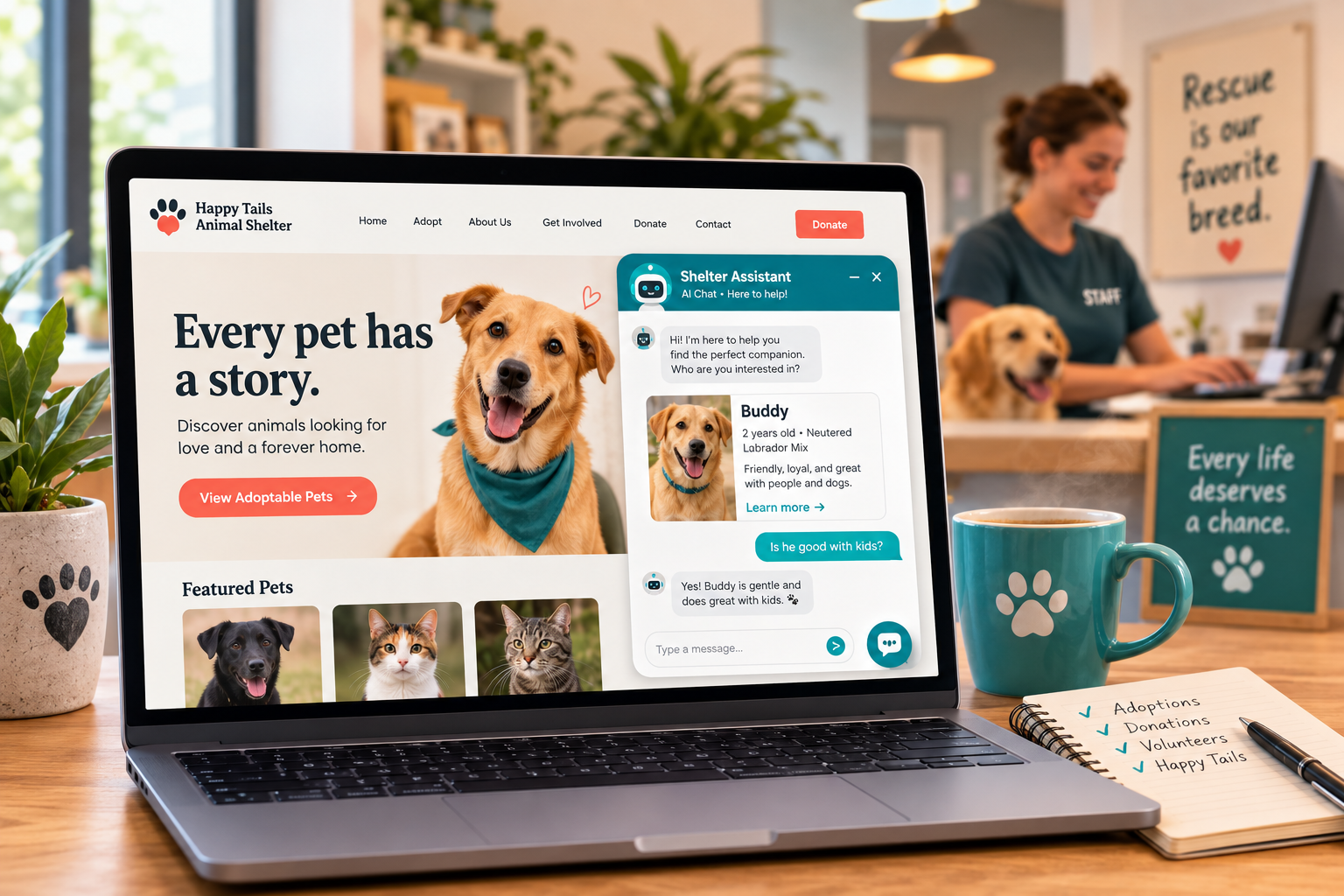
Animal-specific questions. “Is Bailey still available?” “Is she good with kids?” “What does her foster say about her energy level?” A chatbot trained on your live animal profiles can answer these questions at 11 p.m. when your adoption coordinator has been offline for three hours. This is the most direct value the tool provides.
Process questions. “How long does the application take?” “Do you do same-day adoptions?” “What is the fee for a senior dog?” These are the questions that eat up staff time during business hours and go unanswered outside of them. A chatbot handles both without requiring a staff member.
Foster and volunteer intake. A visitor who is interested in fostering but unsure whether they qualify can get a first answer from the chatbot. A volunteer who wants to know what shifts are available can get a direction. Neither of these interactions requires a full conversation with staff to move the visitor one step closer to engaging.
Donation context. A visitor on your giving page who has a question about where the money goes can get an answer immediately. This matters because most donation abandonment happens not at the form itself but in the moment of uncertainty right before the visitor reaches it.
What It Does Not Do
The most common expectation I hear from shelter directors considering a chatbot is that it will solve their inquiry problem. It does reduce inquiry volume to staff. But it is not a replacement for your database, your application process, or your people.
A chatbot does not manage your animal records. It reads data from your database – ShelterLuv, Petfinder, or whatever platform you use – but it does not write to it. An animal that gets adopted at 10 a.m. on a Tuesday will still show in the chatbot as available if your database has not been updated. The chatbot is only as current as the data it is reading.
A chatbot does not make adoption decisions. It can collect initial information and direct a visitor to an application. It cannot evaluate whether the match is right, whether the home is appropriate for the animal’s needs, or whether the adopter’s living situation works for that specific animal. Every shelter that has cut corners on the human judgment step of adoption has regretted it. The chatbot does not change that equation.
A chatbot does not fix a broken intake process. If your application is too long, your response time is too slow, or your policies are confusing to the people reading them, the chatbot will surface those problems more clearly than before – because more visitors will reach the friction point. It will not solve them.
The One Thing That Has to Work
The most important technical requirement for an AI chatbot for animal shelters is a live data connection. A chatbot that is not connected to your real-time animal inventory will give wrong answers. Wrong answers from a chatbot are worse than no answers at all, because they create a specific kind of frustration: the visitor who comes to your shelter to adopt the dog the chatbot said was available and finds out it was adopted three days ago.
Before you evaluate any chatbot product, ask one question first: does it connect directly to my shelter management software, and how often does it sync? If the answer is “we pull your Petfinder feed every 24 hours,” that is not live data. If the answer is “we have a direct integration with ShelterLuv that syncs in real time,” that is what you need. Everything else about the tool is secondary to this.
What to Ask Before You Buy One
When you are evaluating an AI chatbot for your shelter, three questions tell you most of what you need to know.
How does it get its data? Ask specifically what shelter management systems it integrates with, how frequently it syncs, and what happens to the chatbot’s answers when an animal’s status changes. If they cannot give you a precise, technical answer to this, they have not solved the data problem.
What does it do when it does not know the answer? A chatbot that makes up an answer is a liability. A chatbot that says “I am not sure – here is how to reach our adoption team” is useful. Ask to see what the fallback behavior looks like. Ask what percentage of questions it currently cannot answer for shelter clients similar in size to yours.
What does setup and ongoing maintenance require from your team? Some chatbots take a developer to install. Some take a line of code your web volunteer can add in fifteen minutes. Some require ongoing training and prompt updates from staff. Understand the maintenance commitment before you sign anything. A tool that saves your adoption coordinator ten hours a week should not require your executive director five hours a month to maintain.
The shelter director who asked me what chatbot to buy ended up not buying one yet. She spent thirty minutes going through these questions and realized her shelter management software did not have a direct integration available for any of the chatbot products she was considering. She is waiting for one to build it. That is the right call. A chatbot that cannot connect to your animal data is not a useful tool for a shelter. It is a widget that answers general questions and routes visitors to your contact form – which your contact form already does.

Want to see BarkLogue working on your shelter’s site?
Book a free 20-minute demo and see exactly how it connects to your animal data.
Book a Free Demo →