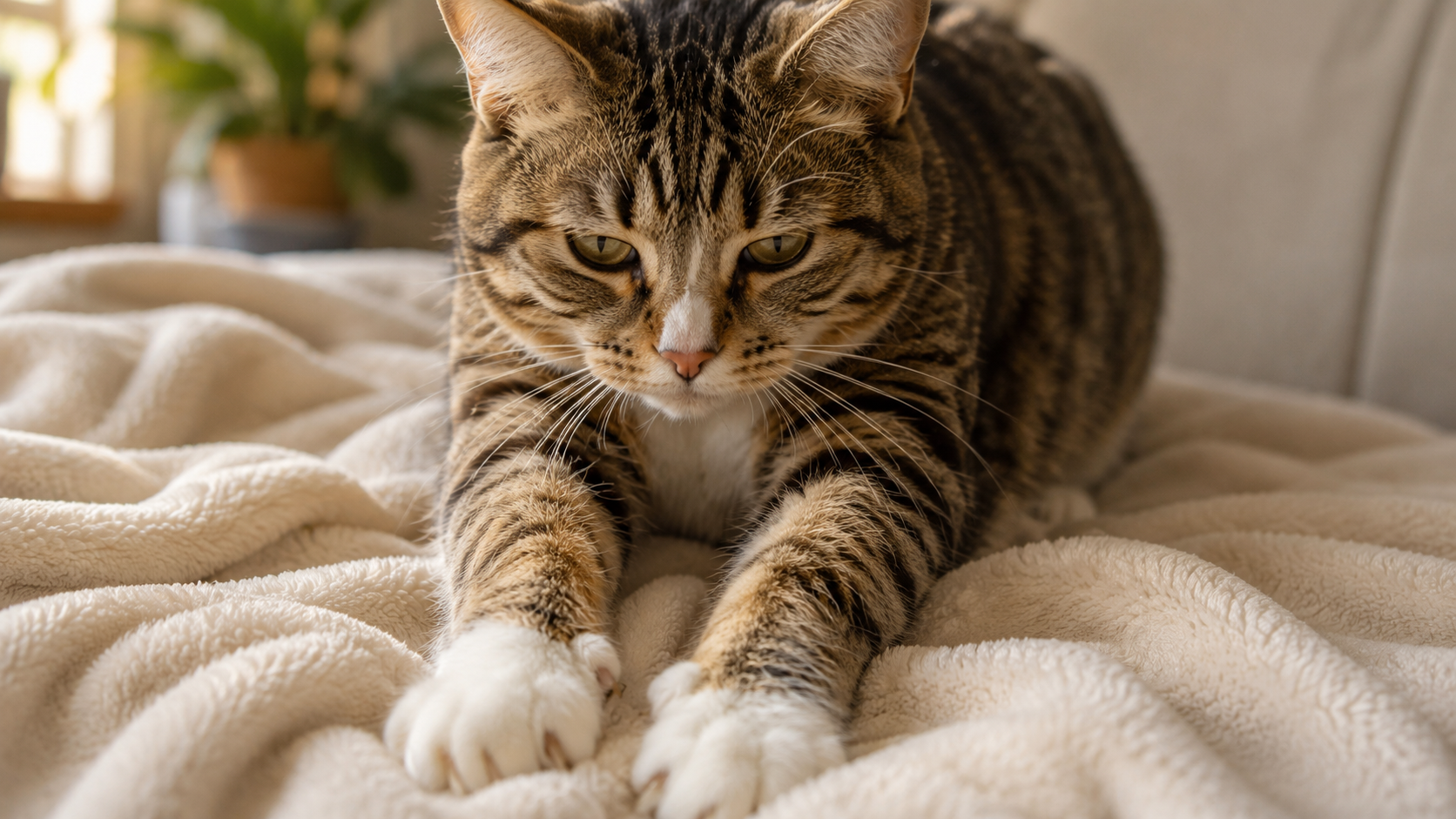
Your cat has settled onto your lap.
- Their front paws are pressing in and out, slow and rhythmic.
- Eyes half-closed.
- A soft purr is going.
- Maybe a little drool.
That’s kneading. Cat people call it making biscuits, and if your cat does it to you.
It means something.
Something good. This post explains exactly what.
What Is Kneading?
Kneading is when a cat rhythmically presses their front paws into a soft surface, one paw at a time.
- It’s normal, instinctive, and almost always a sign your cat feels good.
- It starts in kittenhood. Newborns knead their mother’s belly to stimulate milk flow.
- That motion gets tied to warmth, safety, and a full belly.
Most cats carry it into adulthood because the comfort it brings is worth having.
Here’s something interesting: lions and tigers knead, too. It’s not a quirk. It’s hardwired into the whole feline family.
6 Reasons Your Cat Kneads
1. It Takes Them Back to Their Safest Memory
Nursing was the safest moment of your cat’s early life. Warmth, food, and their mother’s presence.
Kneading was right at the center of it.
Kneading triggers a release of dopamine, the brain’s feel-good chemical.
So when your adult cat kneads your lap, they’re recreating that comfort on demand.
Some cats weaned early knead more often, but any cat can be a kneader.
No matter how long they nursed.
2. You’re Warm, Soft, and You Smell Like Safety
There’s a reason your cat kneads you and not the hardwood floor.
- You’re warm.
- You’re soft.
- you smell familiar.
When a cat picks a person over an object to knead.
It’s because your scent and body warmth trigger the same feeling they had while nursing.
You’ve become their version of their mother. That’s not a joke. It’s one of the biggest compliments a cat can give.
3. They’re Claiming You
Cats have scent glands between their paw pads. Every press deposits pheromones onto whatever they’re kneading.
When your cat kneads your lap, they’re marking you as theirs. Their message to every other animal nearby: “This human belongs to me.” It’s territorial. But it’s also very loving.
Both things are true.
4. They’re Making Their Bed
Wild cats kneaded grass and leaves before resting.
It softened the surface and checked for anything hiding underneath. Safety and comfort in one motion.
Your cat inherited that instinct. That’s why kneading often happens right before a nap.
They’re preparing their spot. You just happen to be it sometimes.
5. It’s a Stretch
Kneading flexes the muscles in a cat’s shoulders, front legs, and paws.
Think of it as a slow morning stretch before settling in.
You’ll often see it right after a long nap, when muscles are stiff and the motion feels good.
6. Sometimes It’s Self-Soothing
Because kneading releases dopamine, cats sometimes use it to calm themselves down.
A change at home, a new pet, a disrupted routine can all trigger it.
Happy kneading comes with relaxed eyes, loose muscles, and often a purr.
Anxious kneading looks more urgent. It may pair with hiding or overgrooming. Context tells you which is which.
What Your Cat’s Kneading Style Tells You
Not all kneading is the same. Here’s what each style usually means.
- Gentle, slow kneading: Your cat is content. They feel safe and at ease.
- Kneading with claws out: Deep comfort and strong emotion. Not aggression. They’re just feeling it a lot.
- Kneading + purring + slow blink: The full trifecta. Your cat is as peaceful as they get.
- Kneading + drooling: Very strong nursing-memory recall. These are genuinely the happiest cats. It’s a little gross, honestly, but it means a lot. haha.
- Rapid or frantic kneading: Check the rest of the body. A tense posture, flat ears, or a flicking tail alongside frantic kneading usually means anxiety, not contentment.
Why Does My Cat Knead Me and Not Anyone Else?
Cats tend to knead the person they feel most bonded to. Usually the one who feeds them and is around the most.
- Your scent is the most familiar thing in your cat’s world.
- Your warmth and the feel of your clothes have built up a comfort association over time.
- You are their safest place.
If your cat saves their biscuit-making for you, you’re their chosen person.
That’s not random.
⚠️ Fear Removal: If your cat kneads others but not you, don’t worry about it. Cats show love in many ways. Slow blinking, headbutting, sitting nearby. Not every cat uses the same love language. It doesn’t mean your bond is weaker.
What If My Cat Never Kneads?
Some adult cats just don’t knead much. That’s completely normal.
Many cats shift to other ways of showing contentment.
- Slow blinking,
- headbutting,
- purring beside you, or
- just choosing to be near you when they could be anywhere else.
Same message. Different style.
A cat that doesn’t knead is not an unaffectionate cat. They just say it differently.
Some breeds do tend to knead more. Siamese, Ragdolls, and Birmans are known for it.
But individual personality matters more than breed.
What to Do (and Not Do) When Your Cat Kneads
Do let them. Kneading is instinctive. Suppressing it causes stress and doesn’t work.
1. Do trim their nails. Short nails make kneading far more comfortable for you. Introduce nail trims slowly with treats. The American Association of Feline Practitioners recommends regular nail care as part of routine cat health.
2. Do use a blanket. Keep a folded blanket on your lap when your cat settles in.
They get to knead. Your skin stays intact.
3. Do redirect to a dedicated spot. Pick a soft blanket in a cozy corner.
When your cat kneads somewhere you’d rather they didn’t, calmly move them there and offer quiet praise.
Be consistent. It takes time, but it works.
4. Don’t punish it. Yelling, pushing them away, or spraying water doesn’t stop kneading.
It damages trust and can make anxiety-driven kneading worse.
5. Don’t declaw. Declawing removes the tips of a cat’s toes, not just the nail.
It causes chronic pain and lasting behavioral problems. It is never the right answer.
The Cornell Feline Health Center has clear guidance on safe nail care at home.
6. When to call your vet: If kneading increases and pairs suddenly with overgrooming, hiding, appetite changes, or restlessness, a vet check-in is worth it.
Sudden behavioral shifts always deserve attention.
Before: Your cat kneads you and you’re not sure if it’s sweet, strange, or something to worry about.
After: You know exactly what it means, why they do it to you specifically, and how to handle it comfortably.
Common Questions People Ask
Is it okay to pet my cat while they’re kneading?
It depends on the cat. Some love it. Others want to be left alone in their moment.
Watch the body language. Soft eyes and loose muscles mean they’re happy with the company.
Flat ears or tension means give them space.
Why does my cat drool while kneading?
It’s a very strong nursing-memory recall. Your cat is so relaxed that their body is basically reliving kittenhood.
It’s completely normal and actually means they’re extremely happy.
My cat only kneads at night. Is that normal?
Very normal. Kneading is part of many cats’ pre-sleep routine. They’re doing their bedtime ritual.
Nothing to worry about.
💡 Use the decoder below to find out exactly what your cat’s kneading is saying right now. Takes 30 seconds.
What Should You Do Next?
Next time your cat kneads, watch the full picture.
- Soft eyes?
- Purring?
- Slow blink?
Notice the style and what’s happening around it.
Once you can read those signals, you’ll know your cat’s mood at a glance.
For more pet care guides written for real owners, visit BarkLogue. And check out our guide to understanding your cat’s body language to go deeper on what your cat is communicating every day.
Frequently Asked Questions
Q: Why does my cat knead?
Kneading is rooted in kittenhood nursing. Cats carry it into adulthood because it releases dopamine and recreates feelings of comfort and safety. It’s instinctive and almost always a positive sign.
Q: Is kneading always a sign my cat is happy?
Usually yes. Happy kneading comes with relaxed eyes and often a purr. Anxious kneading looks more urgent and pairs with other stress signals. Body language around the kneading tells you which it is.
Q: Is it okay to move my cat when they’re kneading?
Yes, gently. Move them to a soft blanket or their dedicated kneading spot. Keep your movements slow and calm. It won’t break your bond.
Q: Why does my cat knead and then bite me?
Usually overstimulation. Cats have a threshold for physical contact. A gentle bite means “I need a little space now.” Watch for early signals like a flicking tail before it gets to that point.
Q: Can excessive kneading be a sign that something is wrong?
Sometimes. A sudden increase paired with overgrooming, appetite changes, hiding, or restlessness can signal stress or discomfort. If the change is abrupt and persistent, schedule a vet visit.