There is no single best AI chatbot for pet adoptions, only the one that scores highest against a specific shelter’s own visitor volume, animal turnover, and staffing constraints. Generic “best chatbot” roundups compare features that matter to online retailers and support desks, not to a shelter trying to match a specific dog with a specific household before that dog gets returned two weeks later.
Quick Answer
The best AI chatbot for pet adoptions is the one that scores highest on five criteria specific to shelters: per-animal personalization, adoption-workflow integration, data handling for donor and adopter information, staff time to maintain, and cost relative to your actual traffic. A generic customer-support chatbot can score well on support metrics and still be the wrong tool for adoption matching.
What “Best” Actually Means for a Shelter, Not a Consumer Brand
Most chatbot comparison content is written for online retailers evaluating cart-abandonment recovery or support desks evaluating ticket deflection. Neither use case maps cleanly onto a shelter’s actual problem, which is connecting a specific visitor to a specific animal before that visitor leaves the site, and doing it in a way that reduces mismatched adoptions rather than just increasing message volume.
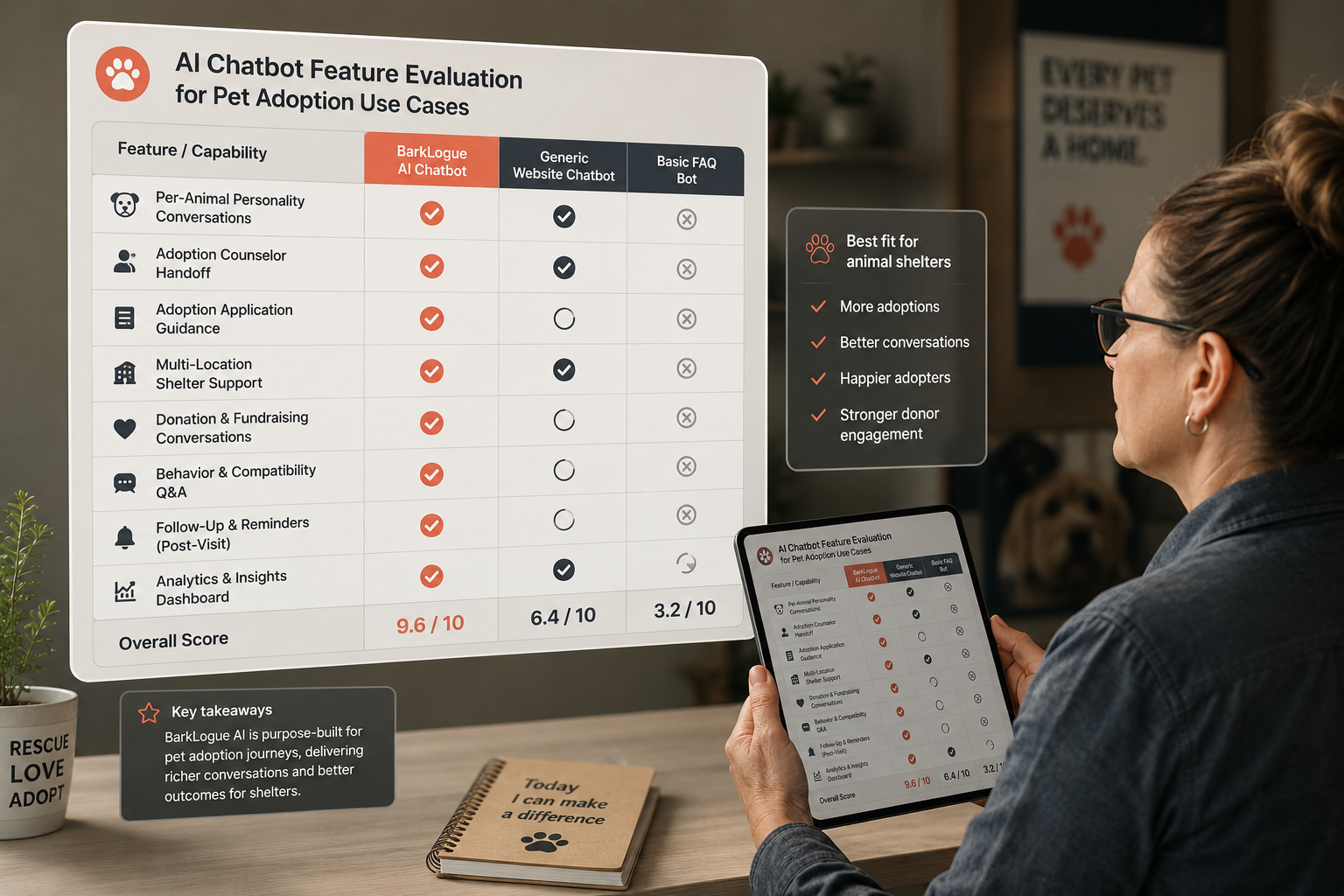
A generic, rule-based FAQ bot and a per-animal conversational widget both fall under the “AI chatbot” label, but they answer fundamentally different questions well.
| Capability | Generic FAQ Chatbot | Per-Animal Adoption Widget |
|---|---|---|
| Answers “what are your hours” | Yes | Yes |
| Speaks to a specific animal’s temperament | No | Yes, per profile |
| Updates automatically as animals are adopted or added | Rarely | Yes |
| Pre-screens for household fit (kids, other pets, space) | Only with custom setup | Built-in to the adoption use case |
Neither column is universally “better.” A small rescue with three animals and heavy social-media traffic may genuinely be fine with a simpler FAQ tool. A shelter managing 40+ active listings with daily turnover has a much stronger case for per-animal matching.
This split exists because the two categories were built by different companies solving different problems for different customers. General-purpose platforms like Tidio, Drift, and ManyChat originated as customer-support and marketing-automation tools for ecommerce and SaaS businesses, and animal shelters represent a small, secondary use case they can technically serve but were not designed around. Category-specific adoption platforms exist because that gap was real: a widget that can hold a conversation as if it were the animal itself, using that animal’s actual profile data, is a narrower and more specialized product than a generic support bot, and it is evaluated on a different set of criteria as a result.
Why Adoption-Specific Matching Is a Real Evaluation Criterion, Not a Nice-to-Have
Mismatched adoptions carry a real cost to shelters, both in staff time and in the animal’s welfare, and that cost is part of why matching quality belongs in a vendor scorecard rather than being treated as a marketing feature.
30%
of community dog and cat intakes nationwide in 2025 were owner relinquishments and surrenders, up slightly from 29% the year before. Some share of that figure reflects animals returned or re-surrendered after a mismatch between household and animal, not just first-time relinquishment.
Source: Shelter Animals Count, 2025 Annual Data Report (ASPCA program), 10 years of national sheltering data.
This does not mean a chatbot single-handedly prevents surrenders. It means the underlying case for adoption-specific matching, over a generic FAQ tool, rests on something more concrete than a feature checklist: reducing the odds that a visitor adopts an animal whose needs don’t fit their household in the first place.
It’s worth being direct about the limits of this data point. Shelter Animals Count reports the 30% relinquishment figure at the intake level, meaning it counts all owner surrenders, not specifically animals returned after being adopted through a shelter’s own website versus a shelter visit, a rehoming site, or a personal connection. No public, shelter-specific study currently isolates how much a website chatbot’s matching quality moves that number up or down. What the figure does establish credibly is the scale of the underlying problem a vendor’s matching claims are supposed to address, which is the honest way to use this stat: as evidence the problem is real and sizable, not as proof that any specific product solves it.
A Scoring Framework You Apply to Any Vendor
Rather than trusting a “best of” list written for a different industry, score each vendor a shelter is evaluating against the same five criteria, using a simple 1-3 scale (1 = does not meet the need, 3 = fully meets it).
The Five-Criteria Scorecard
- Per-animal personalization: Does the bot speak to individual animal profiles, or only generic FAQ content?
- Adoption-workflow fit: Does it route interested visitors into your actual application process, or dead-end at “contact us”?
- Data handling: Where is donor and adopter information stored, and does the vendor answer this clearly without hedging?
- Staff time to maintain: Realistically, how many hours a month will someone spend updating profiles and reviewing conversations?
- Cost relative to your traffic: Does the pricing model (flat, per-conversation, or view-based) match how your visitors actually arrive, in steady flow or occasional spikes around adoption events?
A vendor scoring 12-15 across these five criteria is a strong fit for a shelter running active per-animal adoption content. A vendor scoring under 9 is likely better suited to a narrower FAQ or donor-support role, not a full adoption-matching use case, regardless of how it markets itself.

Run this scorecard against your current chat setup on a live call and see where the gaps actually are.
Book a Demo CallRed Flags That Should Disqualify a Vendor Immediately
Independent of the scorecard above, a handful of answers during a demo should end the conversation regardless of price or feature list.
- Vendor cannot explain in plain language where adopter and donor data is stored or who has access to it
- Pricing is quoted only as “custom, contact sales” with no willingness to give even a range before a demo
- The bot cannot be updated by shelter staff directly and requires a support ticket for every animal profile change
- No trial period or sandbox environment is offered before a contract is signed
These are baseline trust and operability questions, not advanced evaluation criteria, and a vendor unwilling to answer them clearly in a first conversation is unlikely to improve once a contract is signed.
Red flags matter more than incremental feature differences because they predict how a vendor relationship behaves after the contract is signed, not just how the product performs in a demo. A platform that scores a 13 out of 15 on the criteria above but hedges on data storage is a bigger long-term risk than a platform scoring a 10 that answers every operational question directly. Feature gaps can usually be worked around or requested as a roadmap item. Vague answers about data handling or an unwillingness to let staff self-serve profile updates tend to be structural, baked into how the vendor built and prices the product, and rarely change after signing.
How to Run a Two-Week Evaluation Before You Commit
Most reputable platforms offer a trial period. Shelters that skip a structured evaluation and go straight to a year-long contract are the ones most likely to end up locked into the wrong tier for their actual traffic.
Two-Week Evaluation Checklist
- Load your five highest-traffic animal profiles into the trial and confirm the bot references them accurately, not generically
- Have two staff members test it as if they were adopters, including at least one edge case (a household with young kids, an existing pet, or an apartment restriction)
- Track how many conversations required human handoff versus were resolved by the bot alone
- Confirm exactly what happens to the conversation data after the trial ends, before signing anything
A two-week window is enough to surface whether a platform’s actual behavior matches its sales demo, which is where the gap between an advertised “best” chatbot and the right chatbot for a specific shelter usually shows up.
Frequently Asked Questions
Is a per-animal chatbot always better than a generic FAQ bot for adoptions?
Not universally. A rescue with very few animals and low website traffic may not need per-animal personalization; the scorecard framework above is meant to be applied to your own volume and traffic, not treated as a fixed ranking.
Can a chatbot actually reduce return-to-shelter rates?
No independent, shelter-specific study currently isolates a chatbot’s causal effect on return rates. The reasonable claim is narrower: better upfront matching information reduces the odds of an obvious mismatch, which is one contributing factor among many in a return or re-surrender.
How long should a shelter trial a chatbot before committing?
Two weeks is generally enough to surface whether the bot’s real behavior with your actual animal profiles matches what was shown in a sales demo, provided staff actively test it rather than letting it run passively.
What questions should disqualify a vendor outright?
Vague answers about data storage, refusal to give even a price range before a demo, no staff-editable profiles, and no trial period are all reasonable reasons to move on regardless of the vendor’s feature list.
The Bottom Line on Choosing
“Best” is a marketing word, not an evaluation criterion. A shelter that scores each vendor against its own animal volume, staffing, data-handling needs, and traffic pattern will end up with a defensible answer specific to its own operation, which holds up better under board scrutiny than a ranked list written for a general audience that has never managed an adoption workflow. The scorecard, the red-flag checklist, and a two-week trial are not extra steps standing between a shelter and a fast decision. Together they are the fast decision, compressed into a process that produces an answer a shelter can actually defend six months later.