Your couch arm is shredded.
There is a tuft of fabric hanging off the chair corner.
And your cat?
Completely unbothered. Possibly smug about it.
Here is the thing: you cannot stop a cat from scratching.
It is hardwired into them. What you can do is redirect it to a spot you are both fine with.
And once you understand why your cat scratches WHERE they do, that redirection gets a lot simpler than most people expect.
First Thing to Know -You Cannot Stop Scratching
Scratching is not bad behavior, and your cat is not doing it to annoy you.
- Cats scratch to mark territory.
- keep their nails healthy.
- stretch their muscles.
- release stress.
Since scratching is a natural instinct, it cannot be completely stopped.
The goal is not to stop scratching.
The goal is to redirect it to a place that works for both of you.
Why Is Your Cat Scratching That Spot Specifically?
Most people focus on stopping the scratching. The better approach is understanding why your cat chose that spot in the first place.
1. Territorial Scratching
Cats often scratch visible areas like couch arms near doors, hallways, or windows.
These locations help them leave both visual and scent markers.
2. Stretch Scratching
This usually happens near sleeping areas.
After waking up, cats naturally stretch and scratch the nearest tall surface.
3. Stress Scratching
If scratching suddenly increases or appears in new locations, stress may be a factor.
Scratching helps some cats relieve tension and self-soothe.
4. Texture and Feel
Sometimes there is no deeper reason.
Your cat simply likes the feel of a particular material and keeps returning to it.
Understanding the reason makes it much easier to choose the right scratcher and placement.
Why Most Scratching Posts Fail
Many scratching posts fail because they do not meet a cat’s needs.
- A post that is too short prevents a full stretch.
- A wobbly post feels unsafe.
- The wrong material may not be satisfying.
Poor placement is another common problem because cats prefer scratching where they already spend time.
Also, do not rush to replace a worn post. Many cats actually prefer well-used surfaces they can really dig into.
How to Choose the Right Scratcher
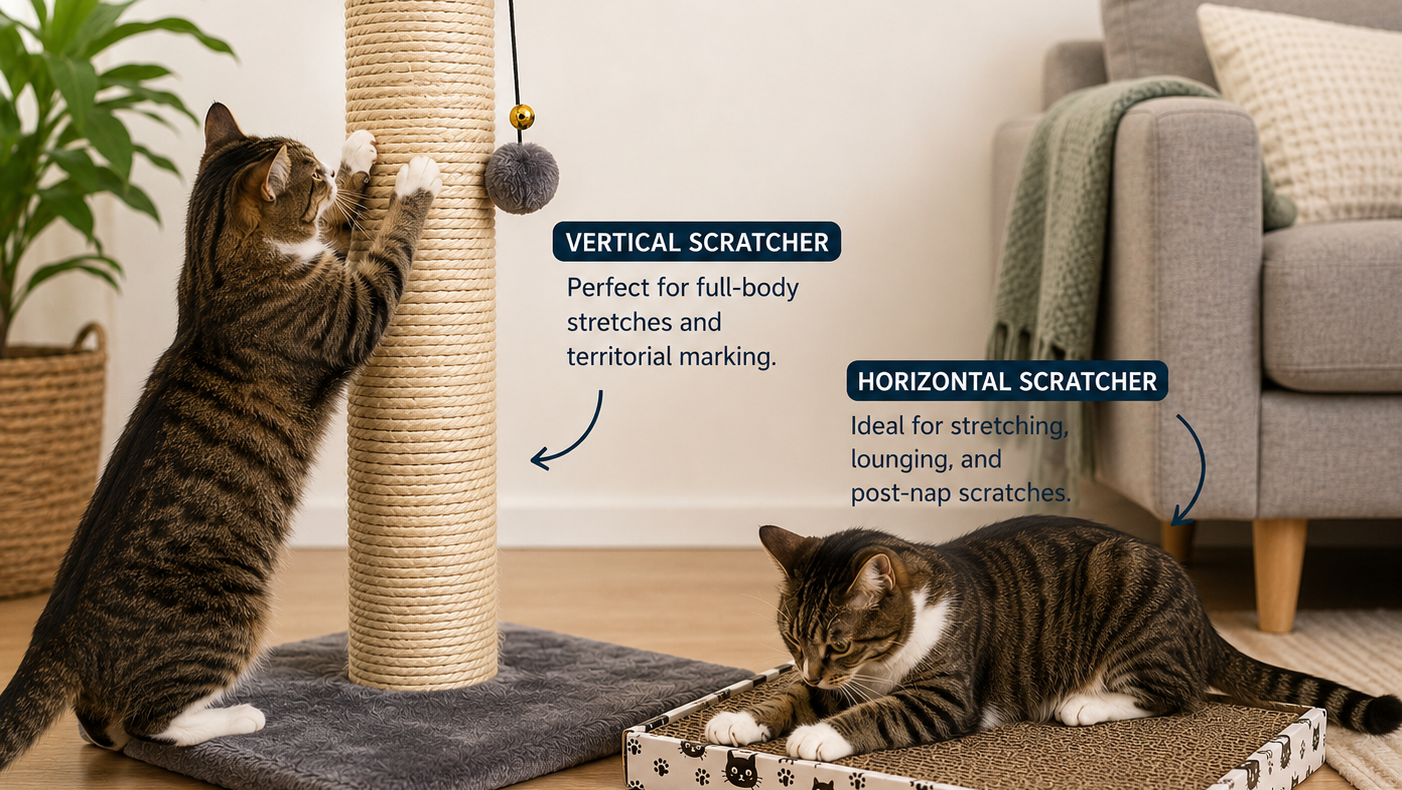
1. Choose a vertical or horizontal scratcher based on your cat’s habits.
2. Match the material to what they already scratch.
3. Make sure it is tall, sturdy, and stable.
Where to Put It (The Step Most People Get Wrong)
Where you place the scratcher matters.
- Put it right next to the furniture your cat is scratching.
- For territorial scratching,place it near entryways or windows.
- For stretching, keep it close to sleeping areas.
- In multi-cat homes, provide several scratchers around the house.
Once your cat uses it regularly, slowly move it to a more convenient spot.
How to Get Your Cat to Actually Use It
- Make the scratcher more appealing than the furniture.
- Try sprinkling a little catnip on it or placing a toy nearby.
- Some cats are also drawn to the sound of you scratching the surface.
- When your cat uses the scratcher, reward them with praise, treats, or play.
- Avoid forcing their paws onto it, as this can create a negative association.
⚠️ Fear Removal: If your cat has ignored every post you have tried so far, that does not mean they cannot be redirected. It almost certainly means the post was the wrong height, in the wrong spot, or made of the wrong material. Try again with this list in mind. It usually works.
Gentle Ways to Protect Your Furniture While You Redirect
Deterrents can help protect furniture while your cat learns to use a scratcher.
Double-sided tape, citrus scents, and pheromone sprays may make furniture less appealing. Furniture covers, corner guards, and regular nail trims can also reduce damage.
Nail caps are another temporary option that help prevent scratches.
Just remember: deterrents work best when your cat has an appropriate place to scratch.
What Not to Do
Avoid declawing, as it can cause long-term pain and behavior problems.
Do not punish, yell at, or spray your cat with water. These methods increase stress and do not teach proper scratching habits.
Never force your cat onto a scratching post or hide it in an unused area.
Most importantly, be patient. Redirecting scratching behavior can take several weeks of consistent training.
When Scratching Signals Something Deeper
If your cat suddenly starts scratching much more than usual, stress or anxiety may be contributing to the behavior.
In these cases, solving the furniture problem alone may not be enough. The scratching is often a symptom of a larger issue.
If the behavior continues despite redirection.
- If it is accompanied by hiding,
- appetite changes,
- or withdrawal.
Consider seeking advice from a veterinarian or feline behavior specialist.
Common Questions People Ask
1. Will my cat ever stop scratching furniture completely?
Probably not entirely. However, most cats can be redirected to appropriate scratching surfaces so the behavior is no longer destructive.
2. How long does it take to redirect scratching behavior?
Most cats adjust within two to four weeks when the scratcher matches their preferences and is placed correctly.
3. Can I use citrus spray directly on my cat?
No. Citrus spray should only be applied to furniture or areas you want your cat to avoid.
What Should You Do Next?
Take a look at where your cat scratches most often.
If it is near a doorway or window, the behavior is likely territorial. If it is near a sleeping area, it is probably part of a stretching routine.
That simple observation will help you choose the right scratcher and place it where your cat is most likely to use it.
Frequently Asked Questions
Q. Why is my cat suddenly scratching more than usual?
Changes in routine, new pets, visitors, or other sources of stress are common triggers for increased scratching.
Q. Should I cover my furniture to stop my cat from scratching?
Furniture covers can help protect surfaces during training, but they should always be paired with a suitable scratching alternative.
Q. My cat ignores every scratching post I buy. What am I doing wrong?
The most common issues are poor placement, the wrong material, a post that is too short, or a base that is not stable enough.
Q. Are nail caps safe for cats?
Yes. When applied correctly, they help prevent damage without affecting a cat’s ability to stretch and scratch naturally.
Q. Can I use aluminum foil to stop my cat from scratching furniture?
Some cats dislike the sound and texture of foil, while others ignore it. It can be useful as a temporary deterrent.
Q. How many scratching posts does a cat need?
A good rule is one scratching post per cat, plus one extra. Spreading them across different areas of the home usually works best.