A Practical Guide for Shelter Staff and Volunteers
By Herb Locke, Founder of BarkLogue
The Mistake Most Shelters Make
Bonded pairs are listed as two separate animals.
Two profiles. Two photos. Two sets of stats.
Nothing in either listing tells the visitor why these two animals belong together or what it actually looks like when they are.
A visitor scrolling through individual profiles has no reason to consider adopting two animals unless something stops them and makes the case clearly. A dry notation that says “must be adopted with Rex” does not make that case.
The story of the bond does.
Before You Write: 5 Questions to Ask
Find the person who knows these animals best and ask these questions about both of them together, not separately.
- What do they do when they are separated, even briefly?
- How do they sleep?
- Who takes the lead in new situations and how does the other respond?
- What do they do together that they would never do alone?
- What would it feel like to come home to both of them?
The answers to these questions are the profile.
The 3-Part Formula for Bonded Pair Profiles
Part 1: Open with the bond, not the individuals
Do not introduce them separately. Introduce the relationship first.
Bad: “Rex is a 5-year-old mixed breed. Daisy is a 4-year-old mixed breed. They are bonded and must be adopted together.”
Good: “Every time Daisy leaves the room, Rex sits at the gate and waits. He does not pace. He does not bark. He just waits until she comes back. They have been doing this for six years and neither of them has any intention of stopping.”
The bond is the story. Lead with it.
Part 2: Show what the bond looks like in specific detail
One or two concrete observations that make the relationship real.
Not: “They are very close and love each other.”
This: “Daisy sleeps with her head on Rex’s back every night. Rex has never once moved while she is sleeping there.”
Specific details do what adjectives cannot. They let the reader picture the animals in their own home.
Part 3: Make the case for two
Most people do not consider adopting two animals because nobody has ever framed it as an advantage rather than a complication.
Do that work in the profile.
“Two animals who already love each other means no slow introduction, no territorial adjustment, no figuring out the social dynamics. They arrive as a complete unit. You just provide the home.”
Then name the right person.
“If you have the space for two and have been thinking about it, Rex and Daisy are the easiest version of that decision you will find.”
Before and After
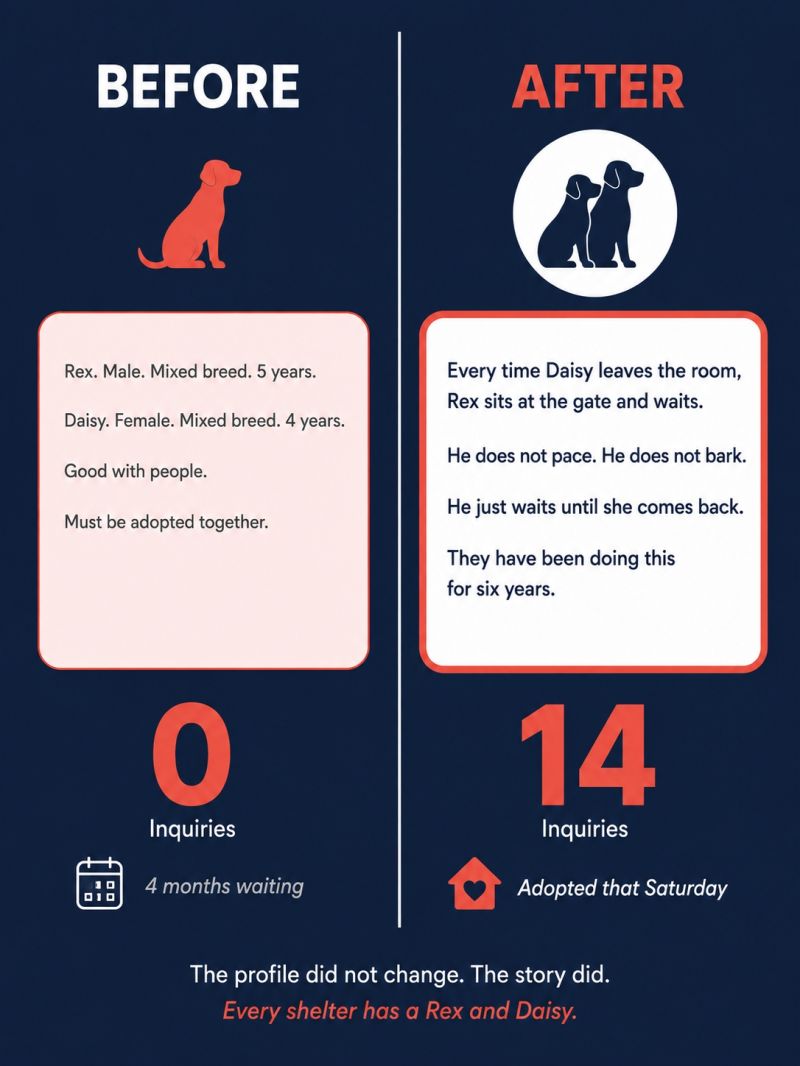
Before: “Rex. Male. Mixed breed. 5 years. Good with people. Must be adopted with Daisy. Daisy. Female. Mixed breed. 4 years. Good with people. Must be adopted with Rex.”
Four months at adoption events. No inquiries.
After: “Every time Daisy leaves the room, Rex sits at the gate and waits.
He does not pace. He does not bark. He just sits there until she comes back. They have been doing this for six years.
Daisy sleeps with her head on Rex’s back every single night. Rex has never once moved while she is sleeping there.
They arrived together and they have never spent a night apart. They are not two animals who happen to get along. They are a unit.
Adopting them means bringing home two animals who already know how to love each other, which means no slow introduction, no adjustment period, and no guesswork. They just need a home that has room for both of them.
If you have been thinking about two, Rex and Daisy are the easiest version of that decision you will find.”
One inquiry within a week. Adopted the following Saturday.
Three Things That Kill Bonded Pair Adoptions
Listing them separately with a footnote “Must be adopted with Daisy” at the bottom of Rex’s profile is easy to miss and harder to feel. The bond needs to be the headline, not the fine print.
Framing two animals as a burden Phrases like “requires adopting both” or “will only go together” position the bond as a condition rather than a feature. Reframe it. Two animals who already love each other is a gift, not a complication.
Using the same photos for both profiles If you are listing them separately anywhere, give each animal their own photos that show their individual personality. But always include at least one photo of them together, ideally one that shows the bond in action rather than two animals sitting side by side.
The Quick Checklist
- Does the profile open with the relationship rather than individual descriptions?
- Have you included at least one specific detail that shows the bond in action?
- Have you made the case for two rather than treating it as an obstacle?
- Is there at least one photo of them together that shows something real?
- Does the ending name the right adopter rather than pleading for any adopter?
Created by BarkLogue. Helping shelters tell the stories that find animals homes. barklogue.com