A practical guide for shelter staff, volunteers, and rescue operators
By Herb Locke, Founder of BarkLogue
Before We Start
I want to tell you about Bear.
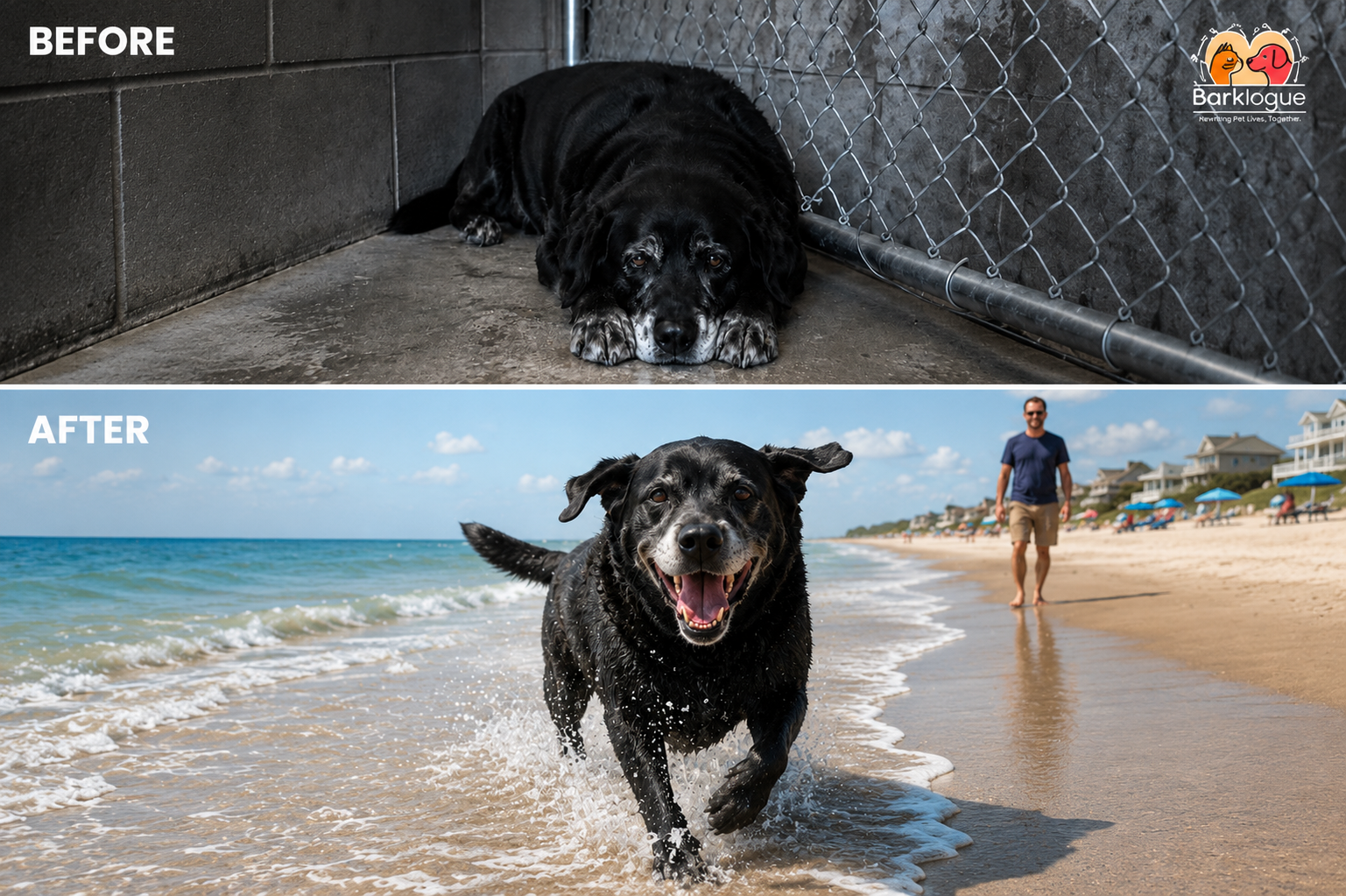
Bear was a 9-year-old black Labrador mix at a shelter in Alberta. Big dog, quiet, kept to himself. His adoption profile said: “Black lab mix, 9 years old, large breed. House-trained. Good with adults.”
He sat in that kennel for 847 days.
Then one volunteer asked a question nobody had thought to ask. “What does he actually love doing?”
Turns out Bear brought you a sock every time you walked through the door. Not to play. Just to give you something. He’d groan loudly when you stopped scratching behind his ears. He loved lying with his head on your feet in the sun.
They rewrote the profile around those details.
He was adopted in 11 days.
Bear was never the problem. The profile was.
This guide is going to show you exactly how to write profiles like the second one, not the first. No writing experience needed. No extra time. Just a different set of questions and a simple formula.
Section 1: Why Most Profiles Fail
Most animal profiles describe what an animal looks like and list what it can tolerate.
Medium-sized tabby cat, approximately 4 years old. Spayed. Up to date on vaccinations. Good with other cats.”
That is a medical record, not a profile. It tells a potential adopter nothing about who this animal actually is.
Here is the problem. When a person adopts an animal, they are not adopting a breed or an age or a size. They are adopting a personality. They are asking: will this animal fit into my life? Will we connect?
A profile that lists physical traits and tolerances cannot answer that question. Only a profile that describes who the animal is can do that.
The good news is that every animal in your shelter already has a personality. You do not need to invent anything. You just need to ask the right questions and write down what you find.
Section 2: The One Rule That Changes Everything
Before we get into the formula, there is one rule that overrides everything else.
Describe who the animal is, not what they look like.
Appearance is the first thing an adopter will see in the photo. They do not need you to describe it again in the text. What they cannot see in a photo is personality, habits, quirks, and the small details that make an animal an individual.
Those details are your job.
When you sit down to write a profile, ask yourself this question before you write a single word: If this animal could not be photographed, what would make someone fall in love with them?
Write that.
Section 3: The 10 Questions to Ask Before You Write
Talk to the staff member or volunteer who knows this animal best. Ask them these questions and write down exactly what they say. Their words are often better than anything you will come up with at a desk.
About personality and behavior:
- What is the first thing this animal does when you walk into the room?
- What is their favorite part of the day?
- What do they do that always makes you laugh or smile?
- What are they afraid of, and how do they show it?
- What do they love more than anything?
About habits and quirks:
- Do they have any funny habits or rituals? Anything that is uniquely them?
- How do they ask for attention?
- What is their energy like? Walk us through a typical day.
- What kind of home do you think they are waiting for?
About their story:
- What do you wish every potential adopter knew about this animal before they met them?
Write the answers down word for word. Do not paraphrase yet. The raw answers are gold.
Section 4: The 4-Part Profile Formula
Every strong animal profile has four parts. They do not need to be long. Each part can be one to three sentences. The whole profile should be between 150 and 300 words.
Part 1: The Opening Detail
Start with one specific, concrete detail that makes this animal real. Not a description of their appearance. Not a generic statement. One specific thing that only this animal does.
Bad opening: “Meet Luna, a beautiful 3-year-old tortoiseshell cat looking for her forever home.”
Good opening: “Luna has a system. Every morning, she sits on the left side of the windowsill and chirps at the birds outside for exactly 20 minutes. Then she finds the nearest warm human and falls asleep on their feet.”
The specific detail is what stops a person from scrolling past.
Part 2: Who They Are
Two to three sentences describing their personality. Use the answers from your 10 questions. Focus on how they interact with people, what they enjoy, and what makes them distinctly themselves.
Avoid vague words like “loving,” “gentle,” or “sweet.” Every profile uses those words. Instead, show what loving looks like for this specific animal.
Not this: “Max is a loving and affectionate dog who enjoys cuddles.”
This: “Max will find you wherever you are in the house. He does not need to be on you. He just needs to be in the same room, usually about two feet away, watching to make sure you are okay.”
Part 3: What They Need
Be honest here. If an animal needs an experienced owner, say so. If they need a quiet home without children, say so. Honesty here is not a deterrent, it is a filter. The right adopter will see the requirement and think, that is exactly what I can offer.
Dishonest profiles lead to returns. Honest profiles lead to lasting adoptions.
Part 4: The Invitation
End with a sentence or two that invites the reader to take a step. Not a plea. Not pressure. Just a warm, open door.
“If you have a sunny apartment and a patient heart, Charlie might be exactly who you have been looking for.”
Section 5: Before and After Examples
Example 1: Senior Dog
Before: “Bruno, male, 10 years old, German Shepherd mix. Large breed. Good with adults. Needs slow introductions with other dogs. House-trained.”
After: “Bruno spent the first ten years of his life working. He is retired now, and he is very serious about it.
His ideal day involves a slow morning walk, a long nap in a patch of sunlight, and at least one hour of having his ears scratched while someone watches television. He is calm, quiet, and deeply loyal. He will follow you from room to room, not because he is anxious, but because he has decided you are worth keeping an eye on.
Bruno does best in a calm home with adults. He is not looking for adventure. He is looking for someone to settle down with.
If you have a couch and a quiet life, Bruno has been saving your spot.”
Example 2: Shy Cat
Before: “Daisy, female, 2 years old, domestic shorthair. Shy. Needs a quiet home. No young children.”
After: “Daisy does not trust quickly. That is not a flaw. It is just who she is, and it is worth understanding before you meet her.
When she first arrived at the shelter, she stayed at the back of her space for two weeks. Then one afternoon she walked to the front and sat down and looked at the staff member who had been quietly sitting with her every day. That was her way of saying she had made her decision.
Daisy gives trust slowly and completely. Once she chooses you, she is yours entirely. She will sleep at the foot of your bed, greet you at the door, and sit beside you whenever you are sad, like she knows.
She needs a calm home, patient people, and time. In return, she will give you everything she has.”
Example 3: High-Energy Young Dog
Before: “Rex, male, 1 year old, mixed breed. High energy. Needs experienced owner. Knows basic commands.”
After: “Rex has two speeds: full sprint and deep sleep. There is not much in between.
He knows sit, stay, and come. He learned them in three days because when Rex decides to focus on something, he focuses completely. He is smart, fast, and genuinely happy in a way that is hard to explain without seeing it. His whole body wags when he greets you.
He needs someone who runs, hikes, or has a yard and the energy to match his. He needs training, consistency, and a person who finds joy in an animal that is completely, exhaustingly alive.
If that sounds like your kind of dog, Rex has been waiting for exactly you.”
Example 4: Bonded Pair
Before: “Milo and Biscuit, male cats, 5 years old. Bonded pair, must be adopted together. Indoor only.”
After: “Milo and Biscuit have been together since they were eight weeks old. They have never spent a night apart.
Milo is the talker. He will narrate your morning, your dinner, your phone calls, and anything else he finds interesting. Biscuit is quieter. He expresses himself mostly by sitting directly on whatever you are trying to read.
Together they are a complete system. They groom each other, sleep in a pile, and take turns being brave when something new appears in the house. They are not two cats who happen to live together. They are a unit.
Adopting them means getting two cats who already love each other, who will never need a slow introduction, and who will give you twice the company at no extra effort. The only requirement is that they go together.”
Section 6: Common Mistakes and How to Fix Them
Mistake 1: Starting with the animal’s name and age
“Meet Bella, a 3-year-old golden retriever…”
Every profile starts this way. It blends into the page. Start with a detail or an action instead. Lead with who they are, not what they are called.
Mistake 2: Using words that every profile uses
Loving. Sweet. Gentle. Loyal. Playful. These words mean nothing anymore because they appear in every single profile. Replace them with specific behaviors that show what those words look like for this animal.
Mistake 3: Listing tolerances instead of preferences
“Good with dogs, cats, and children” tells an adopter what the animal can handle. It does not tell them what the animal loves. Both matter, but preferences create connection. Tolerances just eliminate concerns.
Mistake 4: Being dishonest about challenges
If an animal is reactive, resource guards, or needs an experienced owner, say so clearly. Softening the language to make an animal sound easier than they are leads to returns, which are hard on the animal and hard on the adopter. The right person for a challenging animal exists. Help them find each other.
Mistake 5: Ending with a plea
“Please give Daisy a chance. She deserves a loving home.”
This puts emotional pressure on the reader and often has the opposite effect. End with an invitation instead. Tell them what kind of person would be perfect for this animal and let them self-select.
Mistake 6: Writing for every possible adopter
A profile that tries to appeal to everyone appeals to no one. Write for the specific type of person who would be the right fit for this animal. Use language that speaks directly to them. The right adopter will feel like the profile was written for them.
Section 7: The Profile Review Checklist
Before you publish any profile, check it against this list.
- Does the opening sentence describe something specific and unique to this animal?
- Is there at least one concrete detail that only this animal would have?
- Does the profile describe personality, not just appearance and tolerances?
- Have you replaced vague words (loving, gentle, sweet) with specific behaviors?
- Have you been honest about what this animal needs?
- Does the ending invite the right person rather than plead for any person?
- Could this profile describe any other animal in your shelter, or only this one?
If the answer to the last question is “any other animal,” rewrite it. A good profile is specific enough that only one animal in the world could have written it.
Section 8: The Fill-In Template
Use this as a starting point. Fill in the brackets with real details from your 10 questions. Then read it aloud and adjust anything that does not sound natural.
[Animal name] has a habit.
[One specific thing this animal does, a ritual, a quirk, a behavior that is uniquely them.]
[Two to three sentences about their personality, using specific behaviors rather than adjectives. How do they ask for attention? What is their energy like? What do they love?]
[One to two sentences about what they need. Be honest. Name the ideal home environment, the ideal person, any requirements that matter.]
[One to two sentences that invite the right adopter. Name the kind of person who would be perfect for this animal and leave the door open.]
A Final Note
The goal of a good profile is not to make every animal sound perfect. It is to help the right person recognize the animal they have been looking for.
Bear was not perfect. He was old, large, and easy to overlook. But he was specific. He had the sock thing, the sun-patch habit, the groan when you stopped scratching him. Those details made him real.
Real is what gets animals adopted.
You already know these details about every animal in your shelter. You see them every day. All this guide asks is that you write them down.
This guide was created by BarkLogue, the AI platform that gives shelter animals a voice. If your shelter wants help telling animal stories at scale, visit barklogue.com or book a 30-minute call at calendly.com/blang-barklogue/30min